

Key Takeaways
A same day transmission diagnosis can separate a minor adjustment from a major repair before driving makes the problem worse.
- Slipping, delayed engagement, leaks, harsh shifts, and unusual noises deserve prompt attention.
- A proper diagnosis combines conversation, inspection, scanning, testing, and technician judgment.
- A trouble code points to a system area; it does not automatically identify the failed part.
- Cost depends on the vehicle, testing required, symptom pattern, and whether internal damage is suspected.
- Ask for the findings, repair choices, estimated time, warranty terms, and total price before approving work.
When same day transmission diagnosis is necessary
Transmission symptoms can begin as an occasional hesitation and become a serious drivability problem surprisingly quickly. Same day transmission diagnosis is most useful when the vehicle is still showing a change in behavior but has not yet become impossible to move. Prompt assessment gives a technician a better chance to observe the original symptom and helps you make a calm decision about towing or repair.
Warning signs that suggest a transmission problem
Watch for engine speed rising without a matching increase in road speed, a pause before the vehicle moves, or a pronounced bump during a shift. Red or brown fluid under the vehicle, a burning smell, grinding, whining, and a dashboard warning light are also useful clues. These signs can overlap with engine, axle, or electrical faults, so they should be described rather than self-diagnosed.
A vehicle health check can also reveal broader maintenance concerns around tyres, brakes, fluids, and the battery. For general inspection context, vehicle health checks explain why a health check is different from a service or an MOT, even though a transmission diagnosis requires more targeted testing.
Symptoms that require immediate towing
Towing is the safer choice if the vehicle will not move, repeatedly drops out of gear, leaks a large amount of fluid, or makes loud mechanical noises. A burning odor accompanied by slipping is another reason not to continue driving. Continuing under those conditions can turn a contained fault into damage involving additional components.
If the car cannot select drive or reverse, avoid repeatedly revving it to force engagement. Tell the shop what happened, where the vehicle stopped, and whether it can roll safely. That information helps determine the right towing and inspection plan before anyone begins testing.
How drivability affects the urgency of diagnosis
A vehicle that shifts normally when cold but fails after warming up may still be unsafe for a long commute. Intermittent symptoms can disappear by the time the car reaches a shop, while a constant loss of drive usually deserves immediate transport. The key question is whether the driver can control speed and movement reliably in traffic.
A short trip may be reasonable only when a qualified technician has advised it and the vehicle remains predictable. Otherwise, same-day service should mean same-day assessment, not a reason to take a questionable car back onto the road.
Why delaying an inspection can increase repair costs
Low fluid, a worn seal, or a control problem may be less expensive to address than damage caused by continued slipping. Delay does not guarantee a larger bill, but it removes opportunities to catch a problem while fewer parts are affected. It can also make the original symptom harder to reproduce, extending diagnostic time.
The same principle applies when comparing repair estimates: a low initial figure may not include the testing needed to identify the real cause. A clear repair pricing guide is useful as a general reminder to examine what an estimate includes, rather than comparing totals without looking at scope.
What a same day transmission diagnosis includes
A same day appointment is not simply a code scan. The technician should build a history, inspect the vehicle, test the symptom, and explain what the evidence does and does not prove. The exact order varies with the vehicle and complaint, but a sound process moves from the least invasive checks toward deeper testing.
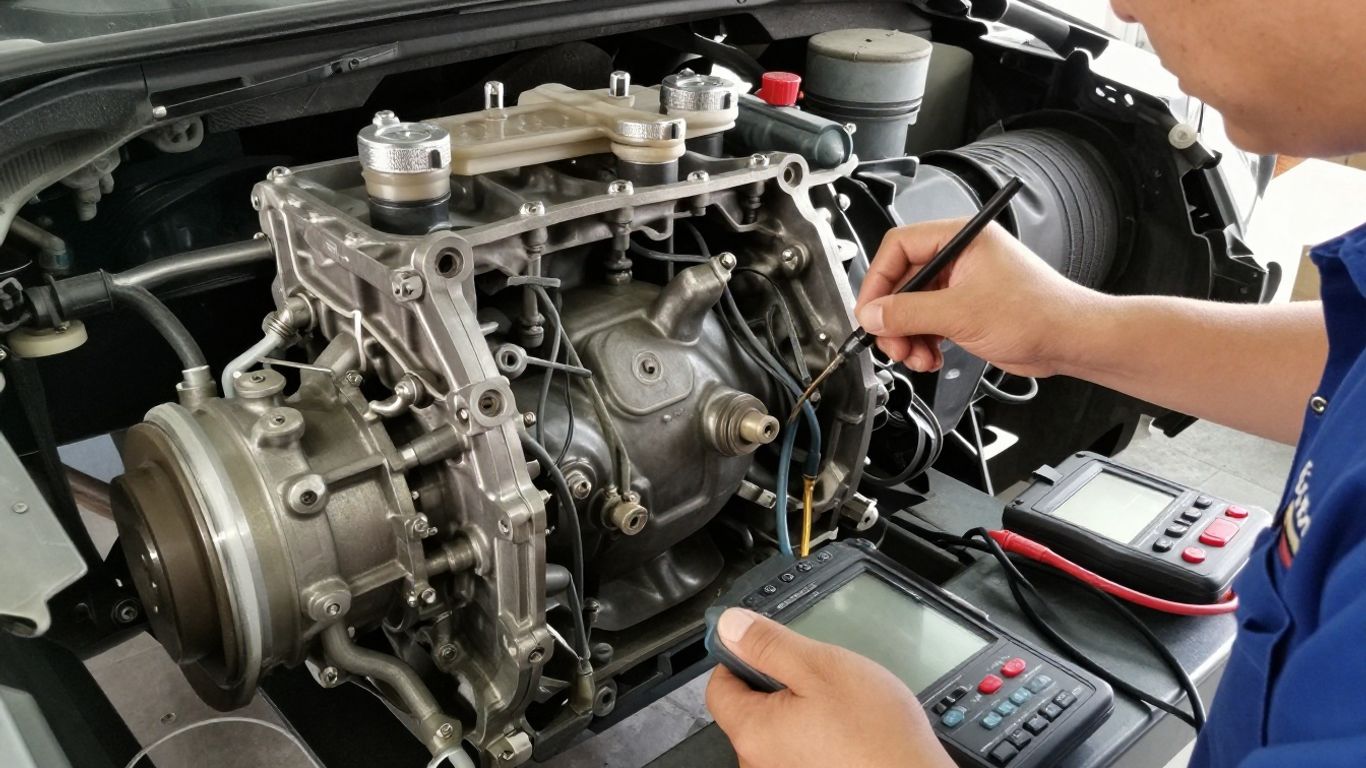
Reviewing the vehicle’s symptoms and service history
The first conversation often provides the most useful diagnostic direction. A technician may ask when the problem occurs, whether the vehicle is hot or cold, which gear is affected, and whether recent battery, engine, or transmission work preceded the change. Maintenance records can reveal fluid services, recurring leaks, or earlier repairs that alter the next steps.
Be specific about what you felt rather than naming the failed part. “The engine revved while climbing a hill” gives better information than “the clutch is bad,” especially before testing has begun.
Inspecting fluid condition, leaks, and external components
Fluid level and condition can offer important evidence, although appearance alone rarely settles the diagnosis. A technician may look for an incorrect level, an unusual odor, contamination, or fresh fluid around the pan, seals, cooler lines, and case. External checks can also include linkage, wiring, mounts, axles, joints, and related drivetrain parts.
These observations help distinguish a service issue from a fault that needs component repair. They also establish whether the vehicle should be driven again after the inspection or kept stationary until a repair is completed.
Scanning for diagnostic trouble codes
A scan can identify stored, pending, or manufacturer-specific codes from the vehicle’s control systems. Those codes may point toward a sensor circuit, shift control, communication issue, or performance condition. They are evidence to interpret alongside symptoms and inspection results, not a shopping list of parts to replace.
A useful diagnostic service connects the code to an observed condition. For example, a technician may confirm whether the wiring, connector, fluid pressure, and mechanical response support the code before recommending work. AAMCO describes a process that combines fluid checks, road testing, external inspection, and computer scanning; those are the kinds of distinct steps a customer can ask a shop to explain.
Performing road tests and hydraulic or electronic checks
A controlled road test lets the technician observe engagement, shift timing, shift quality, downshifts, noises, vibrations, and the conditions that trigger the complaint. Hydraulic testing may help evaluate pressure, while electronic checks can examine sensor signals, solenoids, wiring, and module communication. Safety and vehicle design determine which tests are appropriate.
Testing should produce a reasoned diagnosis rather than a rushed conclusion. If the symptom does not appear, the technician may need to reproduce temperature, load, speed, or gear conditions before giving a reliable recommendation.
How technicians identify common transmission faults
Transmission diagnosis is partly a process of elimination. The same sensation can come from a transmission, engine misfire, axle, mount, transfer case, or control system. Good testing narrows the possibilities without assuming that every warning light or noise begins inside the transmission.
Distinguishing transmission issues from engine or drivetrain problems
An engine that loses power can feel like a delayed shift, while a worn mount can feel like a harsh engagement. A damaged CV joint may click during turns without indicating a transmission fault. Technicians compare engine operation, road speed, gear selection, noises, vibration, and control inputs to separate these possibilities.
That distinction matters because replacing a transmission will not correct an engine performance problem. It also prevents a customer from paying for a transmission repair when a related but different component is responsible.
Evaluating slipping, delayed engagement, and harsh shifting
Slipping often appears as rising engine speed with little acceleration, especially under load. Delayed engagement may occur after selecting drive or reverse, while harsh shifting can involve a sharp bump, incorrect timing, or a failure to downshift smoothly. The pattern, temperature, throttle position, and affected gear all help refine the diagnosis.
A technician may ask for a description of the event and then reproduce it under controlled conditions. The pattern matters most because one isolated jolt and a repeated loss of drive do not carry the same diagnostic meaning or urgency.
Checking solenoids, sensors, wiring, and control modules
Modern transmissions rely on electrical signals as well as mechanical and hydraulic operation. A damaged connector, poor ground, broken wire, incorrect sensor signal, or failed solenoid can change shift behavior without proving that the entire unit is worn out. Testing should follow the circuit and compare expected readings with actual ones.
Control-module codes can be useful, but replacement should follow confirmation of the underlying fault. Electrical diagnosis is especially important when symptoms are intermittent or appear after moisture, vibration, battery work, or another repair.
Identifying signs of internal mechanical damage
Internal damage becomes more likely when there is persistent slipping, metal contamination, repeated loss of a gear, severe noise, or evidence that external and electronic checks do not explain the symptom. The technician may need pressure testing, inspection of removed fluid or components, or partial disassembly to determine the extent.
At that point, the most useful question is not merely whether the transmission is “bad.” Ask which parts show evidence of damage, whether the case or hard parts are affected, and what level of repair is realistic for the vehicle’s age and condition.
What affects the speed and accuracy of diagnosis
“Same day” describes the target for assessment, not a promise that every fault can be confirmed in a few minutes. Some vehicles provide clear data quickly; others need a road test, temperature change, pressure measurement, or additional research. Accuracy matters more than a fast guess, particularly when the recommended repair is expensive.

Vehicle make, model, age, and transmission type
Vehicle design affects access, test procedures, fluid specifications, scan functions, and known failure patterns. An older conventional automatic may need a different approach from a continuously variable, dual-clutch, manual, or electronically managed unit. Mileage and previous repairs also influence what the technician considers plausible.
Bring the exact vehicle information, including engine and transmission details when available. Parts and procedures can vary within the same model year, so precision at check-in prevents avoidable delays.
Access to diagnostic equipment and technical information
The shop needs suitable scan equipment, service information, test adapters, lift access, and the ability to interpret the results. Equipment can retrieve data, but it does not replace hands-on inspection or technician experience. If a fault is manufacturer-specific, access to accurate specifications becomes especially important.
Customers can ask what testing is included and whether the shop expects to complete the diagnosis that day. Transmission diagnostics is a useful phrase to look for when comparing service descriptions, but the practical question remains what the technician will actually inspect and report.
The difference between intermittent and consistent symptoms
A consistent symptom is easier to reproduce, measure, and compare with test results. An intermittent problem may depend on temperature, rain, traffic, battery voltage, road incline, or a particular shift event. A short video or written record can preserve details that disappear once the vehicle is parked.
When a symptom cannot be reproduced, a technician may document likely causes without claiming certainty. That is not necessarily an incomplete effort; it may be the honest limit of the evidence available during the appointment.
Why a complete diagnosis may take longer than an initial scan
A scan is often an early step, not the complete investigation. The next stage may include clearing nothing, checking live data, inspecting connectors, measuring pressure, driving the vehicle, or confirming that a suspected fault returns under the same conditions. Each additional check reduces the risk of replacing an unrelated part.
The shop should explain what is known, what remains unconfirmed, and what further testing would cost. For broader service-planning ideas, a detailed installation timeline guide illustrates why time estimates become more useful when they identify the stages involved rather than offering one vague promise.
Understanding same day transmission diagnosis costs
Diagnosis charges cover technician time, equipment, inspection, and the responsibility of turning symptoms into a defensible recommendation. Some shops include a basic scan in an inspection fee, while others price scanning, road testing, and deeper tests separately. Ask for the starting charge and the conditions that could change it before authorizing work.
Typical charges for inspection and computer scanning
A basic inspection may cost less than a full diagnostic session because it requires fewer steps. Computer scanning can also be a standalone service, but a code report without interpretation may not answer why the vehicle is shifting poorly. Labor rates, vehicle complexity, location, and the time needed to reproduce the complaint all affect the price.
A written estimate should distinguish diagnosis from repair. That separation makes it easier to understand whether you are paying for information, parts, labor, or all three.
When diagnostic fees may apply toward repairs
Some shops credit an inspection fee toward approved repairs; others keep diagnosis separate because the testing has value even when no repair is authorized. Neither structure is automatically better. What matters is that the policy is explained before work begins and appears on the estimate.
Ask whether the credit applies to all repairs or only a particular service, and whether additional testing is approved separately. A clear policy prevents an unexpected change in the final invoice.
Factors that increase testing and labor costs
Costs can rise when a symptom is intermittent, access is difficult, internal components must be inspected, or multiple systems may be involved. A vehicle with a previous repair, incorrect fluid, or damaged wiring may also require more time to establish the cause. Parts availability affects repair time, but it should not be confused with diagnostic time.
For clarity, the main cost drivers usually fall into a few groups:
- Time required to reproduce and measure the symptom.
- Specialized equipment, adapters, or manufacturer information.
- Additional electrical, hydraulic, or internal testing.
- Vehicle access, disassembly, and reassembly.
These factors explain why two apparently similar vehicles can receive different diagnostic estimates. They also give you a better basis for asking what each line of the estimate covers.
How to compare estimates without choosing on price alone
Compare the diagnostic scope, not just the headline fee. One quote may include a road test and fluid inspection, while another may cover only a scan. Check whether taxes, teardown, storage, towing, and follow-up testing are included or excluded.
A low price is less helpful if it ends with a vague recommendation. Favor an estimate that identifies the suspected fault, evidence supporting it, next steps, and the point at which you must approve additional work.
What happens after the diagnosis
Once the evidence is assembled, the technician should explain the condition in plain language and outline realistic choices. The options may range from an adjustment or external repair to fluid service, component replacement, rebuilding, or complete transmission replacement. A diagnosis is useful because it gives those choices a factual starting point.
Deciding between adjustment, component repair, and replacement
An adjustment or external repair may be appropriate when the transmission itself is operating properly and the fault is limited to linkage, wiring, a sensor, a solenoid, a seal, or another accessible component. A component repair can preserve more of the original unit than a full replacement. The recommendation should match the confirmed fault rather than the most expensive possibility.
Ask what will be repaired, what will be tested afterward, and what symptoms may remain unrelated. A clear explanation helps prevent an apparently small repair from being mistaken for a guarantee that every drivability concern is resolved.
When transmission fluid service may be appropriate
Fluid service may make sense when the fluid is due for maintenance, the level is incorrect, or the manufacturer specifies a service procedure that fits the vehicle’s condition. It is not a universal cure for slipping, severe noise, or internal wear. Fluid type, fill method, temperature, and service history all matter.
The technician should explain whether service is preventive, corrective, or simply part of further testing. If the fluid contains substantial debris or the unit has significant symptoms, service alone may not address the underlying damage.
When rebuilding or replacing the transmission makes sense
Rebuilding may be considered when internal wear is confirmed and the vehicle’s condition, value, and expected future use justify the work. Replacement may be more practical when a suitable unit is available, repair time matters, or the original case and hard parts are badly damaged. The best choice depends on warranty, parts quality, vehicle condition, and total installed cost.
Request the written scope, included parts, warranty limits, estimated completion time, and any core or exchange-unit conditions. A recommendation should make clear what is known before disassembly and what might change after internal inspection.
Questions to ask before approving recommended work
A few direct questions can prevent confusion once the vehicle is in the shop. Ask what failed, what evidence supports that conclusion, what alternatives exist, and what happens if the suspected repair does not correct the symptom. Also ask whether the quoted price includes fluid, programming, road testing, taxes, and related replacement parts.
A customer who understands the diagnostic evidence can make a better decision without feeling pressured by unfamiliar terminology. Written answers are especially valuable when the repair involves a rebuild or replacement.
How to prepare for a same day transmission appointment
Preparation does not require technical knowledge. A short record of what happened, when it happened, and what changed afterward can save time during intake. Bring the vehicle information and set aside enough time for questions, because a careful same-day diagnosis may not end with an immediate repair.
Recording symptoms, noises, and shifting conditions
Write down the gear, speed, temperature, road grade, throttle position, and duration of each event. Note whether the symptom occurs during starting, acceleration, braking, turning, or reversing. If safe, a passenger can record sound or dashboard behavior, but never use a phone while driving.
Include what the vehicle did immediately before and after the symptom. A pattern is often more useful than a dramatic description of one unusual shift.
Bringing maintenance records and recent repair information
Bring invoices, fluid-service records, warning-light information, and details of recent battery, engine, suspension, or drivetrain work. Mention any fluid top-up, jump start, towing incident, collision, or aftermarket electrical installation. Even an unrelated recent repair may help explain when the symptom began.
If records are incomplete, do not guess. Tell the technician what you know and identify what is uncertain so the inspection can fill in the gaps.
Confirming appointment availability and expected turnaround
Call ahead to confirm that the shop can perform diagnosis rather than only receive the vehicle. Ask whether same-day means inspection, a written estimate, or completed repair, and whether towing or drop-off is available. Also clarify the diagnostic fee and the time at which additional authorization will be requested.
Keep your schedule flexible if the symptom is intermittent or internal testing may be needed. A realistic turnaround estimate is more useful than a fast promise that leaves important checks unfinished.
Choosing a qualified transmission repair shop
Look for a shop that explains its diagnostic steps, provides a written estimate, and separates confirmed findings from possibilities. Ask who will perform the testing, what equipment is available, and how the work is documented. A transparent conversation is often a better sign than a sweeping claim of certainty.
You can also compare whether the shop works with the vehicle’s specific transmission type and can source suitable replacement parts if needed. For general perspective on checking work quality and final handover, a professional installation process offers a useful analogy: clear stages, defined scope, and a final review all reduce surprises.
A practical comparison should also account for location and service access. A-J & H Transmission is one example of a transmission diagnostic service page that discusses scans and emergency towing; use such descriptions as prompts for questions, not as a substitute for checking the terms of your own appointment.
Conclusion
A same day transmission diagnosis is most valuable when it replaces guesswork with a documented process. Describe the symptoms carefully, authorize testing with clear boundaries, and ask the technician to connect each recommendation to evidence. Whether the result is a minor adjustment, fluid service, component repair, rebuild, or replacement, understanding the reasoning helps you choose the next step with greater confidence.
Frequently Asked Questions
Can a transmission be diagnosed in one day?
Many common faults can be assessed the same day, especially when the symptom is consistent and the shop has suitable equipment. Intermittent issues, internal damage, or hard-to-access components may require more time.
Is a diagnostic scan enough to find the problem?
Usually not. A scan can identify useful codes and data, but a reliable diagnosis also considers symptoms, fluid, external components, road-test behavior, and additional electrical, hydraulic, or mechanical checks.
Should I drive a car that is slipping?
Avoid driving if slipping is severe, engagement is unreliable, fluid is leaking heavily, or the vehicle makes loud noises. Continuing to drive can create additional damage and may make the vehicle unsafe in traffic.
How much does a same day transmission diagnosis cost?
There is no single price because fees vary with location, vehicle complexity, labor rates, and the testing required. Ask whether the quoted fee includes scanning, inspection, road testing, and any credit toward approved repairs.
What information should I give the technician?
Describe when the symptom occurs, which gear is affected, whether the vehicle is hot or cold, what noises or smells appear, and whether recent repairs or fluid service preceded the problem. Records and a safe video can also help.
Does dark transmission fluid always mean the transmission needs replacement?
No. Fluid appearance is one clue, not a complete diagnosis. The technician should consider the fluid level, odor, debris, service history, symptoms, and test results before recommending service or replacement.
Should I approve a repair before the diagnosis is complete?
Generally, approve only the agreed diagnostic work first unless the shop has clearly identified a necessary preliminary step. Before approving repairs, ask what failed, what evidence supports the recommendation, what is included, and what warranty applies.