

Key Takeaways
A mobile transmission repair service can save a disabled vehicle from an unnecessary tow, but not every transmission fault is safe to repair in a driveway. Good diagnosis starts with the symptoms, service history, fluid condition, and diagnostic codes.
- Strange shifting, slipping, leaks, and grinding deserve prompt attention.
- On-site technicians can often handle fluid, electrical, linkage, mount, and some clutch repairs.
- Internal transmission damage may require a workshop, lift, or rebuild facility.
- A written estimate should separate diagnosis, parts, labor, travel, and possible follow-up work.
- Regular fluid checks and sensible driving can help prevent avoidable transmission damage.
When you need a mobile transmission repair service
A mobile transmission repair service is useful when the vehicle is difficult or unsafe to drive but can still be inspected where it sits. The technician may be able to identify a relatively contained fault, complete a minor repair, or explain why the vehicle needs towing. The right decision depends on the symptoms and the vehicle’s condition, not simply on convenience.
Warning signs of transmission trouble
Transmission problems often begin with changes that seem minor: delayed engagement, hard or late shifts, shuddering, slipping, or a new whining or grinding sound. Fluid beneath the vehicle, a burning odor, or a warning light can also point to trouble. A useful transmission maintenance guide covers familiar symptoms such as power loss, difficult shifting, slipping, and unusual noises.
Pay attention to when the symptom occurs. A problem only when cold can suggest a different diagnostic path from one that appears after towing or extended stop-and-go driving. Recording the gear, speed, temperature, and dashboard message gives the technician much more to work with.
Situations that require immediate attention
Stop driving as soon as the vehicle cannot engage a gear, repeatedly drops out of gear, leaks heavily, or produces loud mechanical noise. Continuing to drive with very low fluid can turn a manageable leak or seal problem into extensive internal damage. Smoke, a strong burning smell, or a vehicle that moves unpredictably also warrants caution.
If the vehicle is blocking traffic, parked in an unsafe location, or unable to hold position, move away from it and arrange roadside assistance when necessary. A technician can assess the vehicle, but personal safety comes before an on-site inspection.
Problems a mobile mechanic can safely handle
Many mobile calls involve faults that do not require removing the transmission. Depending on the vehicle and the technician’s equipment, an on-site visit may cover fluid service, an accessible leak, a sensor, wiring, a solenoid, shift linkage, or a transmission mount. A local mobile transmission service page describes fluid draining and refilling as part of an on-location service, which is one example of work that may be practical outside a workshop.
The technician should still confirm the repair boundary before starting. Access, ground conditions, rust, seized fasteners, and the vehicle’s design can make a seemingly simple job unsuitable for driveway work.
When towing to a transmission shop is the better option
Towing is usually the safer choice when internal components may be damaged, the transmission must be removed, or the vehicle needs a lift and specialized rebuilding equipment. It is also sensible when the vehicle cannot be driven without worsening the fault. A mobile diagnosis can still be worthwhile because it may prevent a needless tow or help the owner authorize the correct next step.
Ask whether the quoted inspection includes a recommendation about transport. A careful technician will explain the limitation rather than promise a complete repair before seeing the vehicle.
What mobile transmission repair services include
On-site transmission work ranges from maintenance to targeted component replacement. The exact scope varies by vehicle, access, parts availability, and the technician’s equipment. Before booking, describe the vehicle, its transmission type, the symptoms, and where it is parked.
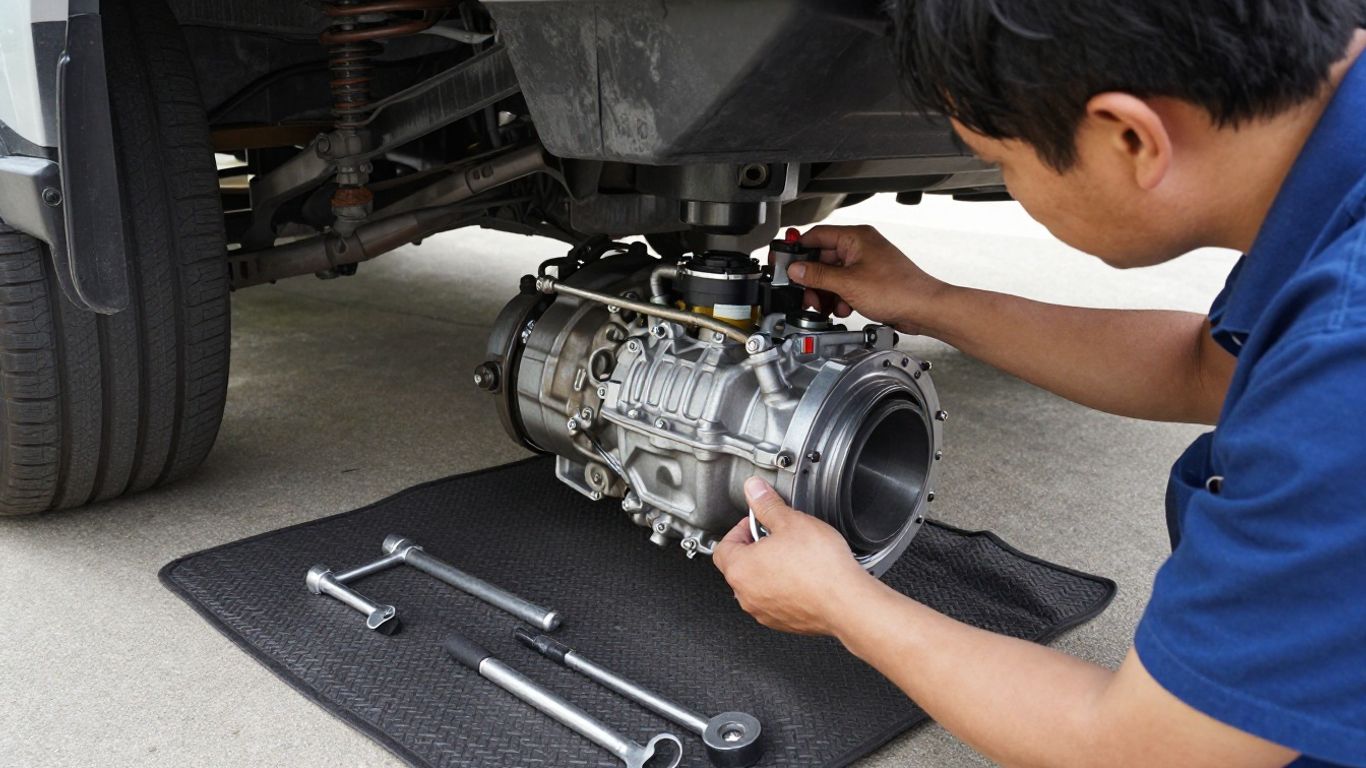
Transmission fluid changes and leak repairs
Fluid service may involve checking the level and condition, draining or exchanging fluid, replacing a filter where accessible, and inspecting for leaks. The correct fluid specification matters; using the wrong product can create shift quality or component problems. A leak repair may be as straightforward as replacing an accessible seal, hose, pan gasket, or cooler line, but the source must be confirmed rather than guessed.
Fluid that is dark, contaminated, or accompanied by a burnt odor deserves more than a cosmetic top-up. The technician should explain whether service is appropriate and whether the vehicle shows signs of deeper damage.
Solenoid, sensor, and electrical troubleshooting
Modern transmissions rely on sensors, solenoids, wiring, connectors, and control modules. A fault in one of these areas can cause harsh shifting, delayed engagement, limp mode, or a warning light even when the gears and clutches are not the original problem. On-site troubleshooting may include checking connectors, testing circuits, scanning codes, and replacing an accessible component.
Electrical diagnosis should be evidence-led. Replacing a sensor solely because a code is present can waste money if the actual cause is damaged wiring, low voltage, fluid contamination, or a mechanical fault.
Shift linkage and transmission mount repairs
A worn or damaged shift cable, bushing, linkage, or mount can make the selector feel loose or prevent the transmission from reaching the chosen range. These parts are often more accessible than internal transmission components, making them potential candidates for mobile repair. The technician should verify that the indicator and the transmission position agree before returning the vehicle to service.
The same inspection can reveal excessive movement, cracked rubber, loose fasteners, or contact between components. Correcting those issues may improve shifting without touching the transmission internals.
Clutch and manual transmission service
Manual transmission complaints may involve clutch adjustment, hydraulic leaks, a worn master or slave cylinder, linkage, or a clutch that no longer disengages correctly. Some hydraulic and linkage repairs can be completed on-site, while clutch replacement generally requires substantial access and lifting equipment. The vehicle’s location and the technician’s tooling determine what is realistic.
A useful clutch repair resource discusses rough shifting, jerking, synchronization concerns, and the role of regular fluid changes. Those symptoms still need vehicle-specific diagnosis rather than an automatic assumption that the clutch itself has failed.
How technicians diagnose transmission problems on-site
Diagnosis is the most valuable part of many mobile visits. It separates a fluid or control issue from internal damage and gives the owner a basis for deciding whether to repair, tow, or monitor the vehicle. A clear process also reduces the risk of replacing expensive parts unnecessarily.
Reviewing symptoms and the vehicle’s service history
The technician will usually ask when the problem began, whether it is constant, and whether it changes with temperature, load, speed, or gear. Information about previous repairs, fluid services, warning lights, towing, and recent impact damage can narrow the possibilities. Bring service records if they are available, even if they are incomplete.
Describe what happened without trying to diagnose it yourself. “The engine revs but the vehicle barely accelerates” is more useful than a conclusion such as “the torque converter is bad.”
Scanning for diagnostic trouble codes
A scan tool can reveal stored, pending, or transmission-related diagnostic codes and provide useful data while the fault is present. Codes do not automatically identify the failed part, however. They are clues that must be compared with symptoms, wiring tests, fluid condition, and mechanical inspection.
Some faults disappear after the vehicle is switched off, so note any warning message before the appointment. Do not clear codes simply to make the dashboard look normal; doing so can remove helpful diagnostic information.
Inspecting fluid, leaks, wiring, and components
A proper inspection may include the fluid level and appearance, leak paths, connectors, grounds, fuses, mounts, linkage, driveshaft areas, and accessible transmission surfaces. The technician may also look for impact damage or signs that a previous repair has come loose. Accurate diagnosis saves money because it directs the repair toward a verified cause.
The inspection should account for practical conditions. A low driveway, poor lighting, heavy rain, or unsafe traffic exposure can limit what can be checked safely and thoroughly.
Confirming whether the issue is mechanical or electrical
Mechanical faults tend to involve worn gears, bearings, clutches, bands, or internal hydraulic problems, while electrical faults may involve signals, solenoids, wiring, or control inputs. The two categories can overlap: an electrical command may expose a mechanical failure, and a mechanical symptom may be triggered by incorrect electronic control.
The technician should explain the evidence in plain language and identify what has been confirmed versus what remains possible. If internal damage is suspected but cannot be proven on-site, the estimate should reflect that uncertainty.
How to choose a reliable mobile transmission repair service
Choosing a technician is not only about finding the fastest arrival time. You want someone who can explain the limits of on-site work, document the diagnosis, and provide a clear price before replacing parts. Local coverage, equipment, insurance, and parts access all affect the quality of the visit.

Verifying certifications, licensing, and insurance
Ask what training applies to the technician and whether the business carries the insurance required to work at private homes, workplaces, or roadside locations. Requirements vary by location, so verify the relevant local rules rather than relying on a vague online badge. The business should also provide a physical contact method and a written record of the work.
Certification is useful, but it does not replace a conversation about the specific vehicle. Ask whether the technician has experience with that transmission type and can access the necessary service information.
Checking reviews and local service coverage
Reviews can reveal whether customers received clear estimates, arrived technicians on time, and received follow-up support when a repair became more complicated. Look for patterns across several recent reviews instead of relying on a single dramatic comment. Confirm that the service area includes the vehicle’s exact location and that travel charges are disclosed.
For broader vehicle assistance, Atlanta’s Mobile Mechanic describes on-site diagnostics and electrical work in its service coverage. That kind of information is useful for comparing what a provider says it handles, though the specific transmission repair still needs confirmation.
Asking about warranties and replacement parts
Before authorizing work, ask whether the repair includes a parts or labor warranty, how long it lasts, and what could void it. Clarify whether the part is new, remanufactured, used, or aftermarket, and whether you may review the old component. A written warranty is easier to understand than a verbal promise.
Parts availability can also change the timeline. A technician may diagnose the vehicle during one visit and return later with the correct component, particularly when the part is uncommon or must be ordered.
Confirming equipment, availability, and repair limitations
Ask whether the technician carries a scan tool suitable for the vehicle, fluid-handling equipment, electrical testing tools, and safe lifting equipment where needed. Confirm whether the appointment is diagnostic only or includes repair time. It is also worth asking what happens if the transmission must be removed or the vehicle cannot be safely driven.
A provider that explains limitations early is generally easier to work with. For comparison, InstantCarFix advertises upfront quotes and a repair warranty in its local service information; the broader lesson is to request those details in writing from whichever provider you choose.
Mobile transmission repair costs and estimates
Transmission prices vary widely because the same symptom can come from a loose connector, a leak, a worn mount, or serious internal damage. Location, vehicle design, parts, labor time, and whether a second visit is needed all affect the total. Treat an early estimate as a working assessment until diagnosis confirms the repair.
Factors that affect the total price
The main cost drivers are the fault itself, access to the component, fluid and parts requirements, diagnostic time, travel distance, and whether special equipment is needed. A repair performed at home may avoid a shop’s transport charge, but mobile labor and travel fees still apply. Taxes, disposal fees, and emergency or after-hours rates should also be clear.
Use the estimate to compare like with like. A low quote that excludes diagnosis, fluid, travel, or follow-up labor may not be cheaper in the end.
Diagnostic and service-call fees
Some providers charge a call-out fee, while others include travel within a defined area. Diagnostic labor may be separate from repair labor, and a successful repair may or may not credit the diagnostic fee toward the final bill. Ask before booking so the appointment does not produce an unexpected charge.
A proper diagnostic fee pays for time, testing, and professional judgment. It should not be confused with a promise that the technician will find a repairable fault within a few minutes.
Comparing repair, rebuild, and replacement options
A targeted repair may be appropriate when the fault is external or limited to a replaceable component. A rebuild involves opening and renewing selected internal parts, while replacement may use a new, remanufactured, or used transmission. The best choice depends on vehicle value, mileage, parts availability, warranty terms, and the evidence from diagnosis.
| Option | Usually suits | Main question to ask |
|---|---|---|
| Targeted repair | External, electrical, linkage, or leak faults | Has the failed component been confirmed? |
| Rebuild | Internal wear with a suitable rebuild path | What parts and warranty are included? |
| Replacement | Extensive damage or limited rebuild value | What is the unit’s source and condition? |
| Further diagnosis | Unclear or intermittent symptoms | What test will reduce the uncertainty? |
This comparison is not a substitute for inspection, but it helps keep the conversation practical. Request the evidence, total price, expected downtime, and warranty for each realistic option before choosing.
Questions to ask before approving the work
A few direct questions can prevent misunderstandings before parts are ordered:
- What fault has been confirmed, and what remains unconfirmed?
- Does the estimate include travel, diagnosis, fluid, parts, labor, and tax?
- Is the proposed part new, remanufactured, used, or aftermarket?
- What warranty applies, and who handles a warranty concern?
The answers should appear on the estimate or invoice. If the technician cannot explain the repair in terms you understand, pause before approving expensive work.
What to expect during an on-site transmission repair
A mobile appointment is usually more efficient when the technician receives a clear description and has safe access to the vehicle. The first visit may be a diagnosis rather than a complete repair. That is normal when the fault requires a part, a second technician, or workshop equipment.
Scheduling the appointment and describing the symptoms
Provide the year, make, model, engine, transmission type if known, mileage, location, and whether the vehicle starts and moves. Describe sounds, smells, leaks, warning lights, and the conditions under which the fault appears. Mention any recent repair, accident, towing, or fluid service.
If the vehicle is not safe to start or move, say so during booking. The technician can then arrive prepared to inspect it without asking you to create additional risk.
Preparing a safe and accessible work area
Park on firm, level ground where possible, with enough room to open the hood and work around the vehicle. Keep children and pets away, remove clutter, and ensure lighting is adequate. Do not ask a technician to work in moving traffic, unstable ground, or a space with inadequate clearance.
Have the keys, registration details, service records, and any relevant dashboard messages ready. Clear access saves time and allows the technician to concentrate on diagnosis.
Reviewing the technician’s diagnosis
Before work begins, ask what was tested, what was found, and which repair is being recommended. A good explanation should distinguish confirmed facts from likely causes and should identify any limitations of an on-site inspection. Review the parts, labor, warranty, and possible additional charges before giving approval.
You can ask for photos of a leak, damaged wiring, or a failed component when practical. Documentation makes the repair easier to understand and useful for future service.
Testing the vehicle after the repair
The final check may include verifying fluid level, clearing or rechecking codes where appropriate, checking for leaks, confirming selector operation, and taking a controlled test drive. The vehicle should be tested under the conditions that originally produced the complaint when it is safe to do so. Ask what symptoms would justify calling the technician back.
Keep the invoice and warranty information. If the problem returns, stop driving if doing so seems unsafe and report the exact symptom rather than simply saying the repair failed.
How to prevent future transmission problems
Prevention is mostly consistent maintenance and early action. Transmission service intervals differ by vehicle, driving conditions, fluid type, and transmission design, so generic schedules should not replace the owner’s manual. Small checks can still catch leaks and changing behavior before they become a breakdown.
Following the manufacturer’s maintenance schedule
Use the specified fluid, filter, inspection interval, and service procedure for the vehicle. Severe use, frequent towing, high heat, steep terrain, and heavy stop-and-go driving may require more frequent attention. Keep records of the date, mileage, fluid specification, and work completed.
When in doubt, ask a qualified technician to interpret the schedule for the vehicle’s actual use. A generator maintenance guide is not about transmissions, but its broader maintenance principle applies here too: routine checks are more useful when they are specific and recorded.
Checking fluid levels, color, and leaks
Inspect for fresh spots beneath the vehicle and pay attention to fluid level and condition when the manufacturer’s procedure allows an owner check. Color alone cannot diagnose a transmission, but a sudden change, burnt odor, or visible contamination deserves professional attention. Never crawl under a vehicle supported only by a jack.
Do not keep driving simply because adding fluid makes the symptom temporarily disappear. A falling level usually means the underlying leak still needs to be found.
Practicing healthier driving and towing habits
Allow the vehicle to engage fully before accelerating, come to a complete stop before changing between reverse and drive, and use the correct towing setup and load limits. Avoid unnecessary wheelspin and aggressive launches, especially when the vehicle is heavily loaded. Heat and repeated strain can accelerate wear even when the vehicle appears to be shifting normally.
If towing is part of regular use, ask whether additional cooling or a different maintenance interval is recommended for that vehicle. Driving habits should match the transmission’s design and the manufacturer’s instructions.
Recognizing early symptoms before they worsen
Respond to delayed engagement, flare-ups in engine speed, shuddering, new noises, fluid spots, or warning lights while the vehicle still moves normally. Early diagnosis may reveal a controllable fluid, electrical, or linkage issue. Waiting until the vehicle will not move usually reduces the number of convenient repair options.
Keep a short record of recurring symptoms, including temperature, speed, gear, and load. That detail can help a technician reproduce the problem and avoid replacing unrelated parts.
Conclusion
A mobile transmission repair service can provide useful diagnosis and practical repairs without moving a vehicle immediately to a workshop. The safest approach is to describe symptoms accurately, ask what has been confirmed, understand the limits of on-site work, and approve only a written estimate you can follow. Regular maintenance and early attention remain the simplest ways to protect the transmission and your budget.
Frequently Asked Questions
Can every transmission problem be repaired on-site?
No. Fluid, wiring, linkage, mounts, sensors, solenoids, and some hydraulic components may be suitable for mobile repair, while internal failures or transmission removal usually require workshop equipment.
Is it safe to drive with a slipping transmission?
Driving with slipping, severe shifting, grinding, or very low fluid can worsen the damage and create a safety risk. Have the vehicle assessed and follow the technician’s advice about towing.
How long does a mobile transmission diagnosis take?
The time depends on access, symptom complexity, scan results, and whether the fault is present during the appointment. A simple inspection may be brief, while an intermittent fault can require more testing.
What information should I give the technician?
Provide the vehicle details, mileage, warning messages, fluid or leak observations, when the symptom began, and the conditions that trigger it. Service records and recent repair details are also helpful.
Should transmission fluid be changed if the vehicle is shifting badly?
Not automatically. The fluid level and condition should be checked first, and the cause of the shifting problem should be diagnosed. A fluid change may help in some situations but cannot repair every internal or electrical fault.
How can I compare two transmission repair estimates?
Compare the same categories: diagnosis, travel, parts type, fluid, labor, taxes, warranty, expected downtime, and possible follow-up work. Ask each provider which fault has been confirmed.
When should I choose a tow instead of mobile service?
Choose a tow when the vehicle cannot safely move, has a major leak, makes loud internal noise, will not engage a gear, or needs lifting, removal, rebuilding, or specialized workshop equipment.