

Key Takeaways
Choosing among transmission rebuild specialists is easier when you focus on evidence rather than a quick promise or low headline price.
- Ask whether rebuilding is appropriate for the vehicle and the actual damage.
- Check training, transmission experience, reviews, and the shop’s diagnostic process.
- Request an estimate that separates labor, parts, and possible additional damage.
- Read warranty coverage and exclusions before authorizing the work.
- Favor specialists who test, explain, and document the repair clearly.
Understand what transmission rebuild specialists do
Transmission rebuild specialists diagnose, disassemble, inspect, and restore transmissions when internal wear or damage makes a simple adjustment insufficient. Their work may involve replacing worn components, correcting hydraulic or mechanical problems, and testing the unit before it returns to the vehicle. The right recommendation depends on the transmission’s condition, the vehicle’s age, and the cost of other options.
A rebuild is not automatically the best answer. A careful shop should explain what has failed, what can be reused, and why rebuilding makes more sense than repairing one external part or installing another transmission. That conversation is often more revealing than a polished advertisement.
Rebuilds compared with repairs and replacements
A repair usually addresses a defined problem without fully disassembling the transmission, such as a damaged sensor, leaking seal, or faulty external component. A rebuild generally requires removing the unit, opening it, cleaning and inspecting its parts, and replacing components that do not meet acceptable condition. A replacement means installing another transmission, which may be new, used, rebuilt, or remanufactured.
The terms are sometimes used loosely, so ask the shop what the quoted service includes. You should know whether the price covers removal and reinstallation, internal inspection, new friction materials, seals, a torque converter, fluid, and post-service testing.
Common transmission problems they diagnose
Specialists may investigate slipping, delayed engagement, harsh shifts, unusual noises, fluid leaks, overheating, shuddering, or a vehicle that will not move in a selected gear. These symptoms can overlap, and a transmission warning does not always mean the entire unit needs rebuilding. Electrical faults, low fluid, driveline problems, and engine issues can create similar behavior.
A useful diagnostic discussion connects the symptom to a test or observation. If the technician can explain what the vehicle is doing, what was measured, and what remains uncertain, you have a better basis for deciding how far the repair should go.
When rebuilding is a practical alternative
Rebuilding can be practical when the transmission case and major hard parts remain serviceable, the vehicle is otherwise worth keeping, and the expected repair cost fits your budget. It may also make sense when the exact replacement unit is difficult to source or when a known specialist can address the causes of failure rather than simply exchanging the unit.
The decision should include the vehicle’s mileage, maintenance history, rust or accident damage, and likely near-term needs. A lower-cost repair may be reasonable when the defect is isolated; a replacement may be more predictable when internal damage is extensive or the vehicle has other serious problems.
How specialists evaluate transmission damage
Evaluation normally begins with the vehicle’s history and symptoms, followed by visual checks, fluid inspection, electronic diagnosis where applicable, and road testing. Once removed, the transmission can be disassembled so the technician can examine clutches, bands, bearings, gears, valves, bushings, and other internal parts. A written diagnosis matters because it gives you something concrete to compare with the estimate.
Ask whether the inspection revealed a confirmed failure or only a suspected cause. A responsible specialist should identify parts that are damaged, parts that are worn but reusable, and parts that may require approval after disassembly. For general background, Transmission Specialists describes transmission repairs, parts, services, and diagnostics, including work on transfer cases and differentials; those are examples of service categories to clarify with any local shop rather than assumptions about every specialist.
Look for qualifications and relevant experience
Credentials do not replace good judgment, but they can show that a shop takes technical training seriously. You also want experience that matches your vehicle, because transmissions differ widely in design, controls, service procedures, and common failure patterns. A specialist who welcomes detailed questions is usually easier to evaluate than one who relies only on broad claims.
Consider the whole business experience as well. Clear communication, itemized paperwork, realistic scheduling, and a documented warranty can matter just as much as a technician’s years in the field.
Certifications, training, and industry memberships
Ask which certifications the technicians currently hold and whether they receive continuing education on newer transmission systems. Training should be relevant to the work being performed, not merely listed as a badge on a website. Industry memberships can also provide access to technical resources, although membership alone is not proof of workmanship.
For example, the Automatic Transmission Rebuilders Association offers technical support, training programs, industry certifications, and a consumer Shop Finder. That makes it a useful starting point for understanding what professional development can look like, while still leaving you to assess the individual shop and its proposed repair.
Experience with your vehicle’s make and transmission type
Give preference to a shop that regularly handles your vehicle’s make, model, year, and transmission family. Ask how often the technicians work on that type and whether they have access to the correct service information and diagnostic equipment. A general answer such as “we work on everything” is less helpful than a specific explanation of familiar systems.
Bring any service records and describe when the symptom occurs: cold or warm, uphill or level, during shifting, or under acceleration. Those details can help the technician avoid treating a vague complaint as a complete diagnosis.
Familiarity with automatic and manual transmissions
Automatic and manual transmissions require different diagnostic thinking and repair procedures. Automatic units may involve hydraulic circuits, solenoids, valve bodies, electronic controls, and torque converters, while manual systems bring clutch, gear, synchronizer, and linkage concerns. Some shops also work on continuously variable transmissions, which have their own service requirements.
Ask directly whether the shop has experience with your transmission type and whether the estimate covers related components that could mimic an internal failure. A specialist who explains the boundaries of the inspection is more trustworthy than one who treats every shifting problem as identical.
Local reputation and customer reviews
Reviews can reveal patterns in communication, billing, scheduling, and how a shop handles problems after the vehicle leaves. Read several recent reviews rather than relying on a single dramatic story. Look for comments that describe the diagnosis and follow-up, not just remarks about friendliness or speed.
You can also ask friends, independent mechanics, or local vehicle groups for recommendations. A strong reputation should be supported by a shop willing to provide a written estimate, explain warranty terms, and let you make an informed decision without pressure.
Compare the diagnostic and rebuilding process
The process tells you more than the word “specialist.” Before authorizing a rebuild, find out how the shop confirms the problem, what happens after removal, which parts are measured or replaced, and how the completed transmission is tested. These details help distinguish a careful rebuild from a quick parts swap.
Do not be uncomfortable asking for a plain-language walkthrough. You are paying for both parts and judgment, and you should understand the sequence well enough to recognize where additional approval might be needed.
The importance of a complete transmission inspection
A complete inspection considers the transmission, related controls, fluid condition, cooling system, driveline, and the circumstances in which the fault appears. The technician may need to rule out wiring, sensors, mounts, axles, the clutch, or engine performance issues before recommending internal work. Skipping those checks can lead to an expensive repair that does not solve the original complaint.
Ask whether diagnostic charges are applied to the rebuild and whether you receive the findings if you decline the work. A transparent policy makes it easier to seek a second opinion without losing the value of the initial inspection.
How specialists identify internal component damage
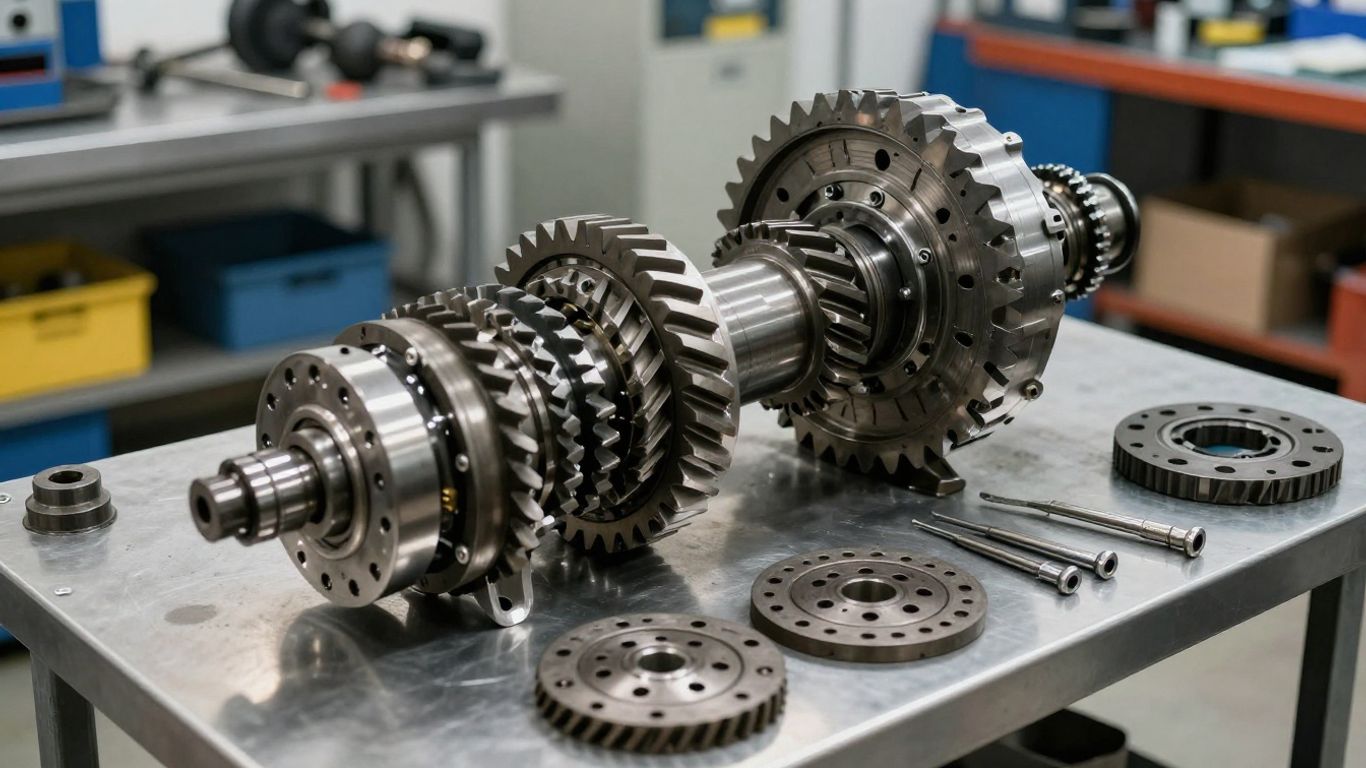
After removal and disassembly, technicians clean parts and inspect them for wear, scoring, cracks, heat damage, warping, or abnormal friction material. Measurements are compared with applicable specifications, and the technician should distinguish normal wear from a part that caused or contributed to the failure. The final recommendation should be tied to those findings.
A useful question is, “Which parts failed, and which parts are being replaced as preventive service?” The answer helps you understand both the necessary work and the choices that may affect durability or price.
Parts selection and remanufactured component options
Estimates should identify whether parts are new, remanufactured, rebuilt, or reused after inspection. Ask about the source and warranty of major components, and whether the rebuild includes updated parts when appropriate. Reusing a part can be sensible when it meets specification, but the shop should explain that decision rather than leave it ambiguous.
Do not assume that “remanufactured” means the same thing in every quote. Ask what was inspected or replaced, who stands behind the component, and whether the part warranty is separate from the shop’s labor warranty.
Testing procedures before the transmission is returned
A completed transmission should be checked for leaks, correct fluid level, engagement, shift quality, and any diagnostic codes relevant to the vehicle. The shop may need to verify cooler flow, adapt electronic controls, or perform a road test under varied conditions. Ask what testing is completed before delivery and what symptoms would justify a return visit.
The transmission repair diagnostics information available from one transmission service business illustrates why diagnostics, rebuilding, replacement, and maintenance are often discussed as related but distinct services. Use that distinction when comparing estimates: the same label should not conceal very different work.
Evaluate estimates, warranties, and shop policies
Price matters, but a low estimate can become expensive if it excludes removal, additional damage, fluid, programming, or reinstallation. Request the quote in writing and ask which amounts are fixed and which depend on findings after disassembly. A good estimate gives you a practical way to compare shops on equal terms.
Warranty language deserves the same attention as the dollar amount. Coverage may differ for parts and labor, and some policies require maintenance records, approved fluid, or service at the original shop.
What a detailed rebuild estimate should include
A detailed estimate should name the vehicle, describe the recommended work, list included parts and services, show labor, state taxes or shop fees, and identify the warranty. It should also explain diagnostic or teardown charges and the process for approving additional work. Vague phrases such as “complete overhaul” are not enough on their own.
Use the estimate to compare scope rather than simply totals. The table below shows the kinds of details worth placing side by side.
| Estimate item | What to verify | Why it matters |
|---|---|---|
| Diagnosis and teardown | Whether charges apply if work is declined | Prevents unexpected inspection costs |
| Internal parts | Which components are new, remanufactured, or reused | Clarifies the rebuild’s actual scope |
| Removal and installation | Labor, mounts, programming, and adjustments | Shows whether the vehicle will be fully returned to service |
| Fluids and related service | Correct fluid, filter, seals, and cooler requirements | Helps avoid omissions that affect operation |
| Warranty | Duration, mileage, coverage, and claim process | Defines support after payment |
After reviewing the estimate, ask the shop to explain any line that remains unclear. A written document is useful only when both sides understand what it includes.
Labor costs, parts costs, and possible additional damage
Labor often reflects removal, disassembly, cleaning, measurement, rebuilding, installation, diagnosis, and testing, not just the time spent replacing a visible part. Parts costs can change if the technician finds damaged hard components after opening the unit. The estimate should tell you how that possibility will be handled.
Ask whether the shop will pause for approval before exceeding the quoted amount. Also ask whether a replacement transmission, cooler flush, software procedure, or related repair could become necessary. Approval rules protect both sides when the initial diagnosis cannot reveal every internal condition.
Comparing warranty length and coverage terms
Compare what the warranty covers, not only how long it lasts. A longer period may still be limited by mileage, commercial use, towing, modifications, maintenance requirements, or where a claim can be completed. Check whether labor, replacement parts, seals, diagnostics, and consequential damage are included or excluded.
Write down the start date, mileage limit, transferability, and claim procedure. If the warranty requires regular fluid service, ask whether the shop provides a schedule and what records you should retain.
Questions to ask about warranty exclusions
Before signing, ask what circumstances could void coverage and who pays for diagnosis, removal, shipping, or reinstallation if a problem appears. Clarify whether the warranty covers the entire repair or only a particular component. You should also know whether another shop may perform emergency work without losing coverage.
For comparison, a business such as Action Transmission Specialists publicly describes a 3-year/50,000-mile warranty on automatic transmissions. That is a published example, not a standard for every shop, so ask any specialist to provide its own exact terms in writing.
Recognize signs of quality transmission work
Quality work is visible in the way a shop communicates and controls the process. The technician does not need to promise a perfect outcome, but should explain what is known, what is uncertain, and what will happen if the findings change. Clean documentation and careful reinstallation are practical signs of professionalism.
Pay attention to small details, too. Correct fluid, secure connections, leak checks, adaptive procedures, and a meaningful road test can determine whether a rebuild performs as intended.
Clear explanations of the recommended repair
A clear explanation connects your symptoms, the diagnostic results, the internal findings, and the proposed repair. It should distinguish essential work from optional improvements and explain why a particular part is being replaced. If the technician cannot explain the recommendation without hiding behind jargon, pause before authorizing it.
You should be able to repeat the plan in your own words. If you cannot, ask for a written summary or a marked-up estimate before moving forward.
Proper removal, rebuilding, and reinstallation procedures
The shop should use appropriate lifting equipment, protect the vehicle, keep parts organized, and follow procedures for torque, cleanliness, alignment, and electronic setup. During reinstallation, related wiring, mounts, cooler lines, and linkages need careful attention. A rebuilt transmission can perform poorly if an installation detail is overlooked.
Ask whether the shop documents the rebuild and whether removed parts are available for inspection. Policies vary, but a willingness to discuss the process generally signals better communication.
Transmission fluid, seals, and torque converter service
Fluid type and level must match the vehicle’s requirements, and leaks should be addressed rather than treated as a minor afterthought. Seals, filters, gaskets, and the torque converter may be part of the rebuild scope depending on the design and diagnosis. Ask what is included and how the cooler and lines are handled.
These items do not all belong in every rebuild, so the answer should be specific to your transmission. Be cautious of both extremes: a shop that omits necessary related service and one that adds work without explaining its purpose.
Post-rebuild road testing and adjustment
Road testing helps confirm engagement, shift timing, noise, leaks, and operation at different temperatures and speeds. Some vehicles also require relearn or adaptation procedures after service. Ask whether the shop completes those steps before delivery and who will evaluate the vehicle if a symptom remains.
A specialist should tell you what behavior is normal during any break-in period and what requires immediate attention. That guidance gives you a useful baseline instead of leaving you to guess.
Choose the right specialist for your situation
The best choice is not always the closest shop or the cheapest estimate. It is the specialist whose diagnosis fits the evidence, whose scope is clearly documented, and whose warranty and policies you can accept. Take a little time to compare two or three written proposals when the vehicle’s condition allows it.
Your practical needs matter as well. A shop with a strong technical process may still be a poor fit if its schedule, transportation arrangements, or communication policy does not work for you.
Questions to ask before authorizing the work
Prepare your questions before leaving the vehicle so that an urgent repair does not become an automatic decision. Ask these in a calm, direct way:
- What evidence shows that a rebuild is necessary?
- Which parts are confirmed damaged, and which may change after teardown?
- What exactly is included in the quoted price?
- What are the warranty limits and approval procedures?
- What testing and follow-up support are included before delivery?
The answers should be specific enough to appear in the estimate or work order. If a shop refuses to explain its process, another conversation may be worthwhile before you commit.
Red flags that may indicate an unreliable shop
Be cautious when a shop diagnoses a complete failure without testing, refuses to provide a written scope, pressures you to authorize work immediately, or changes the price without explaining why. Claims of guaranteed results, unexplained parts charges, and evasive warranty language deserve similar scrutiny. One unpleasant review is not conclusive, but repeated patterns are worth taking seriously.
You can also question a shop that cannot identify the fluid or transmission type involved. Precision is especially important when several systems can produce similar symptoms.
How to compare turnaround times and transportation options
Ask when diagnosis can begin, how long teardown and parts sourcing may take, and what could delay completion. A promised short turnaround is not useful if the shop has not allowed time for additional damage, programming, or road testing. Get the expected milestones in writing where possible.
Discuss transportation before the vehicle is dropped off. Ask about waiting arrangements, local rental options, shuttle service, storage charges, and how the shop will contact you for approval. The right choice should be workable for your daily responsibilities, not just technically sound.
Steps for maintaining a rebuilt transmission after service
Follow the shop’s break-in and maintenance instructions, use only the specified fluid, and monitor for leaks, unusual shifts, odors, or warning lights. Keep invoices and fluid-service records, since they may be needed for warranty work. Return promptly if the vehicle behaves differently after the rebuild rather than waiting for a small symptom to become a larger failure.
A simple maintenance habit can help: check for fresh fluid spots, pay attention to changes in engagement, and ask about service intervals suited to your driving conditions. If you are also evaluating unrelated vehicle or business information online, apply the same source-checking discipline to AI content terms, home remodeling guidance, needle size conversions, and lens implant options: confirm that a page actually addresses the decision you are making before relying on it.
Conclusion
Choosing transmission rebuild specialists becomes less uncertain when you compare diagnosis, experience, repair scope, warranty language, and follow-up service together. Ask for clear evidence, approve changes in writing, and choose a shop that treats testing and communication as part of the repair rather than as extras.
Frequently Asked Questions
How do I know whether my transmission needs a rebuild?
A rebuild is usually considered after testing and, when necessary, internal inspection show substantial wear or damage. Symptoms alone are not enough because electrical, fluid, engine, and driveline problems can feel similar.
Is a rebuild better than replacing the transmission?
Neither option is always better. The decision depends on the damage, the quality and price of the replacement unit, the vehicle’s condition, and the warranty and support offered by the shop.
What should a transmission rebuild estimate include?
It should describe the work, list parts and services, separate labor and other charges, explain possible additional damage, and state warranty coverage and approval procedures. Ask for clarification before signing.
How long does a transmission rebuild take?
Timing varies with diagnosis, parts availability, shop workload, vehicle design, and whether additional damage is found. Ask for expected milestones rather than relying on a single broad promise.
Should a torque converter be replaced during a rebuild?
That depends on its condition, the transmission design, and the cause of failure. The specialist should inspect it and explain whether replacement, rebuilding, or reuse is appropriate.
What warranty should I expect after a rebuild?
Warranty terms vary by shop and component. Review the duration, mileage limit, parts and labor coverage, maintenance requirements, exclusions, and claim process in writing.
What maintenance helps a rebuilt transmission last?
Use the specified fluid, follow the recommended service schedule, keep records, watch for leaks or unusual operation, and address warning signs promptly. Driving conditions such as towing or heavy traffic may affect the maintenance plan.