
Key Takeaways
Buying a used transmission online can be a practical way to control repair costs, but confidence comes from verification rather than a low sticker price.
- Confirm compatibility with the VIN, engine, drivetrain, and transmission code.
- Compare the complete cost, including freight, labor, fluids, and possible deposits.
- Ask for mileage, testing details, donor information, and included components.
- Read warranty, return, damage-claim, and installation requirements before ordering.
- Plan delivery and installation with a qualified shop before the transmission arrives.
Know whether a used transmission is right for your vehicle
A used transmission is not automatically the right answer for every failing vehicle. The best choice depends on the diagnosis, the vehicle’s value, the availability of matching parts, and how long you expect to keep the car. Before you buy used transmissions online, separate the mechanical decision from the shopping decision.
You may also want to understand the difference between used, rebuilt, remanufactured, and new units. Those labels describe different levels of inspection, replacement parts, and expected cost, so they should not be treated as interchangeable.
Used, rebuilt, remanufactured, and new transmission options
A used transmission typically comes from a donor vehicle and may retain its original internal components. A rebuilt unit has been opened and repaired with selected replacement parts, while a remanufactured unit is generally restored to a defined specification with more extensive inspection and replacement work. A new transmission is usually the most expensive option, but it may offer the clearest parts sourcing and fitment path.
Ask the seller exactly what the label means in that listing. “Used” should lead to questions about mileage and testing; “rebuilt” or “remanufactured” should lead to questions about what was replaced and what warranty applies.
Common symptoms of transmission failure
Slipping, delayed engagement, harsh shifting, grinding, leaking fluid, and unusual noises can all point to transmission trouble. They can also come from a sensor, wiring fault, low fluid level, damaged mount, transfer case, or another driveline component. A proper diagnosis matters because replacing the transmission will not fix a problem that originates elsewhere.
Have a technician scan the vehicle and inspect the fluid and underside before you commit. If the symptoms are intermittent, record when they occur, whether the vehicle is hot or cold, and which gears are affected.
When replacement is better than repair
Replacement can make sense when the transmission has widespread internal damage, repair estimates are uncertain, or a tested replacement is substantially easier to source. Repair may be preferable when the fault is confined to a serviceable component or when the original unit has unusual programming or calibration requirements.
Get the diagnosis and estimate in writing. That gives you a useful basis for comparing a repair with the price, warranty, and installation requirements of a used replacement.
How vehicle age and value affect the decision
Consider the vehicle’s current market value, condition, mileage, rust, tires, suspension, and likely upcoming repairs. A lower-cost transmission may be sensible for a dependable older car, but not if several other major systems are already near the end of their service life. The goal is not simply to find the cheapest part; it is to avoid putting more money into an unreliable overall vehicle.
A qualified shop can help estimate the likely remaining value after the repair. That conversation is especially useful when a warranty covers the part but not all labor or related failures.
Identify the exact transmission you need
Compatibility is the point at which online transmission shopping either becomes efficient or goes wrong. Similar vehicles can use different transmissions because of engine output, drivetrain layout, production changes, or electronic controls. Collect the identifying information before opening a seller’s search form.
Keep photographs of the vehicle identification label and the existing transmission tag. A listing that appears to match by year and model can still be unsuitable if one critical specification differs.
Use the VIN to confirm compatibility
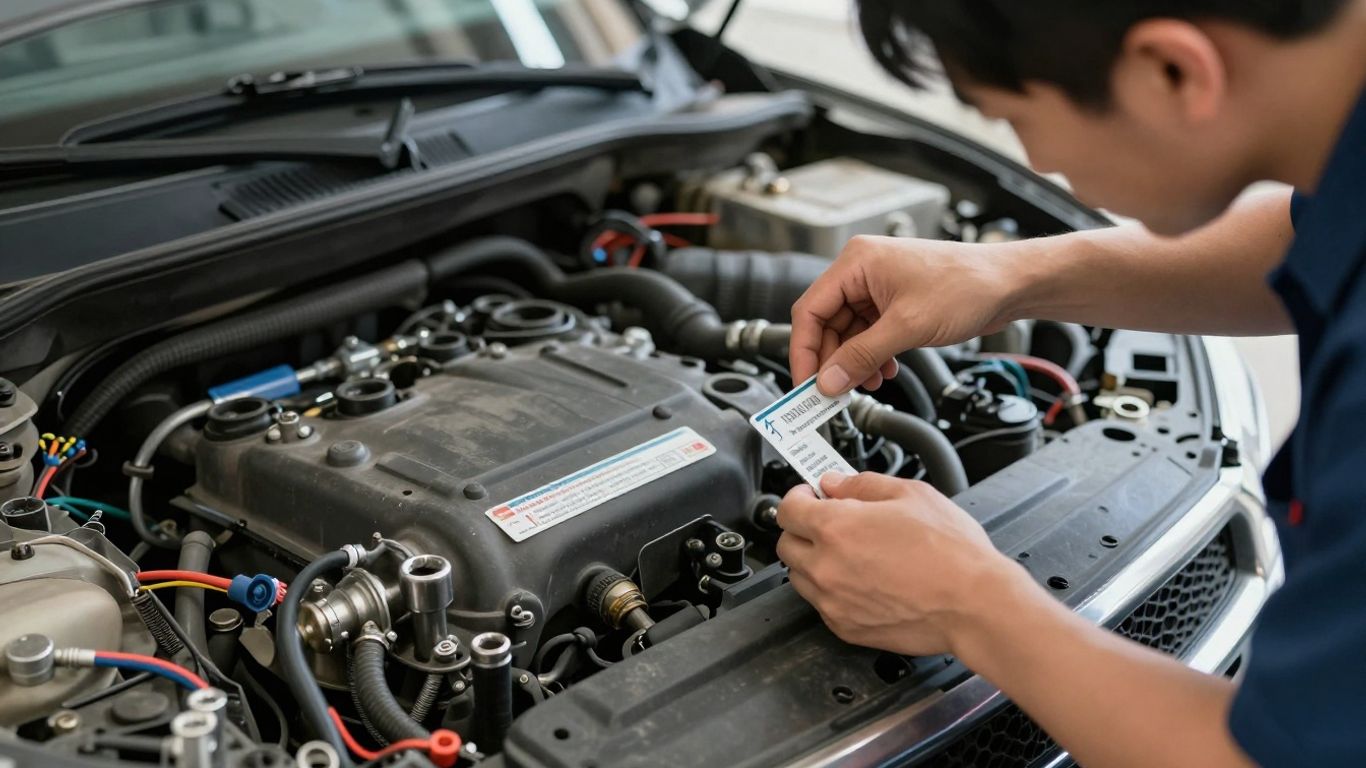
The VIN is the strongest starting point because it identifies the vehicle configuration more precisely than a general model description. Give the full VIN to the seller and ask whether the proposed unit was checked against it, rather than assuming that entering a year and model is enough.
A VIN match does not remove the need for professional confirmation. It should be paired with the transmission code, engine information, and drivetrain details before payment.
Match the year, make, model, and engine
Confirm the exact model year, body style, engine size, fuel type, and transmission type. Midyear changes are common, and the same nameplate may use different components across trim levels. Manual and automatic units are not interchangeable simply because they fit the same vehicle family.
Write the full configuration in your notes and compare it with every field in the listing. If one field is missing, pause and ask rather than filling the gap with an assumption.
Check transmission codes and drivetrain type
Transmission codes can distinguish units that look nearly identical. Also verify whether the vehicle is front-wheel drive, rear-wheel drive, four-wheel drive, or all-wheel drive, and check whether a transfer case or other attached component is included.
The code may appear on a tag, casing, service record, or manufacturer documentation. Photographing the existing unit can help a shop compare connectors, mounting points, sensors, and output arrangements.
Verify mileage and donor-vehicle details
Mileage gives useful context, but it is only one part of a donor-vehicle assessment. Ask where the unit came from, whether the donor was retired because of drivetrain failure, and whether the seller recorded its condition before removal. Inventory pages such as Premium Used Auto Parts describe VIN-verified, run-tested OEM units and donor-vehicle sourcing, which illustrates the kind of detail a buyer should look for in a listing.
Treat mileage as a clue, not a guarantee. A lower-mileage unit with vague history may deserve more scrutiny than a higher-mileage unit with clear testing notes and a usable warranty.
Evaluate online transmission sellers
A seller’s website should make it possible to understand what is being offered before you speak with anyone. Look for clear inventory data, test or inspection information, fitment support, contact details, and policies that remain accessible after checkout. A polished page alone is not evidence of mechanical quality.
For a useful comparison, Nationwide Auto Recycling describes tested and inspected used transmissions, an online parts finder, nationwide shipping, and a 30-day return policy. Those are specific, checkable details; use that standard when reviewing any seller rather than relying on broad phrases such as “top quality.”
Review inventory information and testing standards
A credible listing should identify the transmission type, mileage when available, donor vehicle, condition, and any known defects. It should also explain whether the unit was run-tested, visually inspected, pressure-tested, or simply removed and stored. Ask what the inspection actually covered and whether the results are tied to the specific unit.
Vendors such as B&R describe visual inspections and recorded compression-test findings for their listed parts. While that information concerns the seller’s stated process, the broader lesson is to look for documented, unit-specific inspection notes rather than an unsupported promise.
Compare warranties, return policies, and guarantees
Read the warranty before comparing prices. Check its duration, covered parts, labor limits, exclusions, installation rules, fluid requirements, claim deadlines, and whether a replacement is offered before a refund. Return policies may also impose restocking fees, shipping responsibilities, or conditions involving original markings and undamaged components.
A guarantee is useful only when you understand how it works in practice. Save a copy of the policy and ask the seller to clarify any phrase that could affect a claim.
Check customer reviews and business credentials
Reviews can reveal patterns involving packaging, communication, fitment accuracy, and claims handling. Look for comments across more than one platform and pay attention to recent feedback. Also verify a physical business address, working phone number, clear terms, and a payment method that provides a reasonable transaction record.
Do not treat one glowing review as proof, or one complaint as a complete verdict. Repeated, specific patterns are more informative than vague praise or anger.
Identify trustworthy photos and listing details
Photos should show the actual unit when possible, including the casing, tags, connectors, mounts, and any visible damage. Stock images are not necessarily deceptive, but they should not be mistaken for photographs of the part you will receive. Ask for current photos if the listing does not show identifying features.
Descriptions should also state what is included and what is not. A torque converter, sensors, brackets, wiring, or transfer case may need to be transferred from the original unit, affecting both fitment and labor.
Compare the total cost before buying
The advertised transmission price is only the first line of the estimate. Freight, residential delivery, labor, fluids, seals, programming, and return shipping can change the decision quickly. Build the complete number before you place an order, especially when a cheaper listing has a shorter warranty.
Use the estimate as a planning tool, not a promise. Your installer may identify additional parts after inspecting the vehicle, so leave room for normal service items and an unexpected complication.
Calculate the transmission price and shipping
Request a delivered quote that identifies the unit price, freight charge, lift-gate fee, residential surcharge, and any applicable tax. A transmission is heavy and often ships by freight, so a low online price can become less attractive after delivery charges are added.
When comparing sources, used transmission shipping options can help frame the questions, but confirm the exact charge for your address and the specific unit. Delivery terms vary by seller, carrier, destination, and packaging.
Include labor, fluids, seals, and installation parts
Ask the installer for a written labor estimate and a list of likely replacement items. These may include fluid, a filter, pan gasket, seals, cooler-line service, mounts, fasteners, or programming. The appropriate list depends on the vehicle and the shop’s inspection.
The parts estimate should distinguish required work from recommended work. That makes it easier to compare a used unit with a rebuilt or remanufactured alternative on an equal basis.
Compare warranty coverage with upfront savings
A lower price may be reasonable when the unit has credible testing and suitable coverage. It becomes less attractive when the warranty excludes labor, requires a particular installer, or ends before you can accumulate meaningful driving time. Warranty terms matter because a second removal and installation can cost more than the original price difference.
Use the warranty as part of the purchase value, not as a substitute for fitment research. Even a generous policy cannot make an incompatible transmission suitable.
Watch for core charges and refundable deposits
Some transactions include a core charge or deposit tied to returning the old transmission. Confirm the amount, deadline, packaging requirements, freight responsibility, and conditions for a full refund. Ask whether the old unit must be complete and whether damage affects the credit.
If a core charge applies, photograph the old unit before shipping it back and keep the carrier receipt. Those simple records can prevent confusion later.
Inspect the listing before placing an order
Before checkout, read the listing as if you were preparing a repair file. Capture the stock number, mileage, code, photographs, condition notes, warranty, return terms, and delivery estimate. A saved copy is valuable if the page changes after the order.
This is also the moment to resolve small ambiguities. A missing connector, unclear “assembly” description, or unexplained “as-is” phrase can create a costly disagreement once the part is on the shop floor.
Confirm mileage, condition, and inspection results
Ask whether the mileage is documented from the donor vehicle or estimated from inventory records. Request the specific inspection results for the unit you are considering, including any noise, leak, damage, or missing-component notes. If the seller cannot provide a detail, treat that absence as part of the buying risk.
Condition descriptions should be concrete. “Good” is less useful than “case inspected, tag photographed, run-tested, no external cracks observed,” provided the seller can support the statement.
Ask about storage, maintenance, and removal history
A transmission may have been stored for a long period after removal. Ask how it was drained, sealed, protected from moisture, and handled during storage. Also ask whether the donor vehicle was running, wrecked, flooded, or dismantled because of a drivetrain problem.
These details do not guarantee performance, but they help you judge whether the listing fits your risk tolerance. They can also tell the installer which seals or service steps deserve attention.
Verify included components and fitment requirements
Confirm whether the transmission includes the torque converter, sensors, brackets, transfer case, wiring, fluid, and other attached pieces. Many units are sold as a core assembly only, while the original vehicle may require a particular external component to complete the installation.
Ask whether programming, relearning, or adaptation is required after installation. The answer may depend on the vehicle, control module, and shop equipment, so include the installer in this conversation.
Get important details in writing
Email or message the seller with a short summary of the agreed unit and terms. Include the VIN, transmission code, mileage, stock number, price, shipping destination, warranty, return conditions, and included components. Written confirmation is much easier to use than a memory of a phone call.
Keep invoices, screenshots, messages, and payment records together. Clear documentation supports a return or warranty claim and helps the installer identify what was ordered.
Plan shipping and installation
A successful online purchase still needs a practical delivery plan. Freight carriers may require a suitable unloading area, an appointment, and someone available to inspect the crate or pallet. Coordinate with the repair shop before ordering so the transmission does not sit outside or occupy valuable shop space.
The installation plan should account for the vehicle’s diagnosis, the seller’s requirements, and the timing of any return window. Delaying the inspection can reduce your options if a problem appears.
Choose freight delivery for a heavy transmission
Most transmissions are too heavy and awkward for ordinary parcel delivery. Freight shipping with a pallet or crate gives the carrier a defined handling method and makes damage easier to identify. Confirm the carrier, tracking process, estimated arrival, and whether the shipment is curbside.
Ask the seller how the transmission is drained, secured, wrapped, and protected at vulnerable points. Good packaging cannot prevent every problem, but it can reduce movement and impact during transit.
Prepare for lift-gate and residential delivery requirements
A residential address may require a lift-gate, appointment, or additional fee. Without suitable equipment, a pallet can be difficult to move safely from the truck. Tell the seller and carrier the true delivery setting, including whether the destination is a commercial shop.
Arrange help or equipment before the appointment. Do not improvise with unsafe lifting methods for a dense, irregularly shaped component.
Inspect the shipment for damage before signing
Examine the pallet, crate, casing, connectors, and visible mounting points before signing the delivery receipt. Photograph torn wrapping, crushed corners, leaking fluid, bent components, or any mismatch between the package and the order. Note visible damage on the freight paperwork and contact the seller promptly.
If damage is concealed, document it as soon as the packaging is removed. Keep all packing materials until the seller or carrier explains the next step.
Work with a qualified transmission installer
Choose a shop familiar with your vehicle and ask whether it will follow the seller’s warranty conditions. The installer should verify the unit before fitting it, check related components, use the correct fluid, and complete any required electronic procedure. A careful installation protects both the vehicle and your ability to make a claim.
Schedule the work so the shop can inspect the shipment promptly. If the unit is wrong or damaged, discovering that before installation is far easier than discovering it after the vehicle has been reassembled.
Protect yourself after the purchase
The transaction is not finished when the transmission arrives. Installation records, fluid specifications, test-drive notes, and prompt communication all matter if the unit develops a problem. Follow the seller’s process even when the symptoms seem minor.
A disciplined follow-up also gives you a clearer answer about whether the replacement is operating correctly. Keep the first drives local and leave enough time to test the vehicle before the warranty window closes.
Follow the seller’s installation requirements
Read the warranty instructions again before work begins. Some sellers require professional installation, specific fluids, replacement filters, cooler flushing, or proof of related repairs. Give the shop the written requirements and ask it to document compliance on the invoice.
If a requirement is unclear, obtain an answer before installation rather than assuming it is optional. An avoidable procedural mistake can complicate an otherwise valid claim.
Replace related parts and service fluids
The installer should assess the filter, pan gasket, seals, cooler lines, mounts, and fluid condition. The correct service items vary by vehicle, but reusing a damaged seal or contaminated fluid can undermine a replacement transmission. Ask for the recommended service work to be separated from unrelated repairs.
Keep receipts for fluids and parts. They can help establish what was done and when if a performance issue appears later.
Test the transmission during the warranty period
Drive through the relevant gears under safe conditions and watch for slipping, delayed engagement, harsh shifts, leaks, warning lights, or unusual noise. Allow the vehicle to reach normal operating temperature, since some faults appear only after extended driving. Follow the shop’s break-in or adaptation advice if applicable.
Do not wait until the final week of coverage to report a concern. Early documentation gives the seller and installer more time to diagnose the issue.
Document installation, problems, and communications
Keep the purchase invoice, freight records, inspection photos, installation invoice, scan results, and every message with the seller. Record dates, mileage, symptoms, and any troubleshooting steps. This file makes the next conversation factual instead of speculative.
If a claim becomes necessary, describe the problem precisely and follow the stated return or warranty procedure. A complete record protects your time and gives the seller a fair chance to respond.
Conclusion
To buy used transmissions online with confidence, treat the process as a compatibility and risk-management exercise, not a quick search for the lowest price. Verify the exact unit, investigate the seller, calculate delivery and installation costs, inspect the shipment, and keep careful records after installation. Those steps cannot remove every mechanical risk, but they can make a difficult repair more predictable.
Frequently Asked Questions
Is buying a used transmission online safe?
It can be, provided you verify compatibility, understand the seller’s testing process, review warranty and return terms, and inspect the shipment before signing. The seller’s documentation and your installation plan matter as much as the price.
How do I know which transmission fits my vehicle?
Start with the full VIN, then confirm the year, make, model, engine, drivetrain, transmission code, and any production-specific details. Have the seller and installer review the information before you pay.
What information should a used transmission listing include?
A useful listing identifies the unit, donor vehicle, mileage when available, condition, inspection details, included components, warranty, return policy, and shipping terms. Missing information should prompt questions before ordering.
Should I choose used, rebuilt, or remanufactured?
The choice depends on budget, vehicle value, expected ownership period, availability, and acceptable risk. Compare what was tested or replaced, not just the label attached to the unit.
What extra costs should I expect?
Budget for freight, lift-gate or residential fees, labor, fluid, filters, seals, gaskets, programming, and possible core charges. Ask for a delivered estimate and a written installation quote.
What should I do if the transmission arrives damaged?
Photograph the packaging and unit, record visible damage on the freight paperwork, preserve the packing materials, and contact the seller and carrier promptly. Follow the seller’s stated claim process.
How long should I test the replacement transmission?
Begin testing as soon as the installer confirms the vehicle is ready and continue driving under normal, safe conditions during the warranty period. Report unusual shifting, noise, leaks, or warning lights without delay.