
Key Takeaways
An exchange transmission can shorten a repair by replacing the failed unit with a prepared replacement, but the details matter. Diagnosis, compatibility, core handling, installation, and warranty terms all deserve attention before money changes hands.
- An exchange unit is supplied in return for the failed transmission core.
- Accurate vehicle and transmission identification prevents costly mismatches.
- The quoted price may exclude labor, fluids, programming, freight, or core charges.
- Warranty coverage depends on installation, maintenance, exclusions, and documentation.
- A qualified shop should diagnose the original failure and test the replacement fully.
What a transmission exchange program is
A transmission exchange program provides a replacement transmission while the failed unit is returned to the supplier as a core. The supplier typically uses that core for rebuilding or remanufacturing, subject to its condition and policy. For the vehicle owner, the appeal is practical: a prepared unit may be available sooner than a full rebuild performed from scratch. Still, “exchange” describes the purchasing arrangement, not one universal level of internal work.
The difference between exchange, rebuilt, remanufactured, and used transmissions
These terms describe different things, so they should not be treated as interchangeable. An exchange transmission is sold through a core-return arrangement. A rebuilt transmission has been disassembled and repaired with selected parts, while a remanufactured unit is generally restored to a defined specification using a documented process. A used transmission is removed from another vehicle and sold largely according to its existing condition.
The supplier should explain what inspection, machining, replacement parts, and testing are included. Ask for the written specification rather than assuming that a higher-sounding label guarantees a particular result. A transmission sales policy can also clarify how exchange pricing, core deposits, damaged housings, missing parts, returns, and warranty periods are handled.
How the core-return system works
The core is the failed transmission being exchanged. Depending on the supplier, it may be collected when the replacement arrives, shipped separately, or supplied before the replacement is released. If the old unit is not available at the time of sale, the invoice may include a refundable core charge or deposit.
Before removal, photograph the transmission and note missing brackets, sensors, connectors, and external components. Package it as directed and keep the freight receipt. The supplier then evaluates whether the core qualifies and adjusts the deposit according to the documented policy.
Why exchange programs can reduce repair time
A shop can often order a prepared replacement while the vehicle is being diagnosed, rather than waiting for every internal repair decision to be completed. That can reduce the vehicle’s time on the lift when the correct unit is in stock and shipping is predictable. It does not remove the need for diagnosis, preparation, installation, or testing.
Electronic controls add another scheduling concern. Some vehicles require programming after installation, and reprogramming may also be part of correcting a transmission fault. General transmission reprogramming guidance is useful background, but the shop still needs the equipment and procedures appropriate for the specific vehicle.
When an exchange transmission makes sense
An exchange is worth considering when the failed transmission is clearly identified, the replacement is available, and the supplier offers terms that fit the vehicle’s age and value. It can be especially practical when local rebuilding would take longer or when the shop prefers a unit with a defined inspection and testing process. The decision should be based on the complete installed cost, not only the price printed beside the replacement.
It may be less attractive when the diagnosis is uncertain, the vehicle has substantial unrelated problems, or the core is heavily damaged and likely to produce additional charges. A careful estimate should compare an exchange with rebuilding the existing unit and with other replacement options.
How the transmission exchange process works
A successful exchange follows a chain of decisions rather than a single purchase. The shop first confirms the failure, then identifies the exact transmission, checks the supplier’s terms, and plans the installation. The old unit must be returned correctly, and the replacement must be filled, configured, and tested for the vehicle. Skipping any of those steps can turn a convenient exchange into a repeat repair.
![Technician inspecting a vehicle transmission]
(image:img-1)
Diagnosing the vehicle before ordering
Symptoms such as slipping, delayed engagement, harsh shifts, noise, or fluid loss do not automatically prove that the whole transmission needs replacement. A technician should inspect fluid condition, wiring, connectors, mounts, cooling lines, and related systems, then use suitable diagnostic information to separate mechanical faults from electrical or control problems. The diagnosis should also identify whether contamination or a failed cooler may affect the replacement.
A written diagnosis gives the owner something concrete to compare with the estimate. It should describe the observed fault, the recommended repair, and any checks that remain necessary. For a process involving inspection reports and approval, digital inspection reports illustrate how findings can be documented before work proceeds, although each shop will use its own workflow.
Matching the replacement transmission to the vehicle
The replacement must match more than the vehicle’s make, model, and year. Engine configuration, drivetrain, production date, transmission code, gear ratios, connectors, sensors, calibration, and transfer-case or differential requirements may all matter. The vehicle identification number is a starting point, not a substitute for confirming the transmission itself.
Have the supplier verify the application in writing before ordering. If there are multiple versions in the same model year, provide photographs of identification labels and the original unit’s external features. That small effort is often cheaper than arranging a second shipment after the vehicle is already disassembled.
Returning the failed transmission core
Core handling begins as soon as the old transmission is removed. Drain and secure it according to the supplier’s instructions, preserve the components that must be returned, and avoid disassembling the unit unless permission is given. A core that arrives incomplete, damaged externally, or outside the return window may not receive the expected credit.
The return paperwork should include the invoice or authorization number, shipment tracking, and a description of any unusual condition. Keep copies until the supplier confirms the core disposition. If the core charge is substantial, this paper trail is part of protecting the repair budget.
Installing, flushing, and testing the replacement
Installation is more than bolting in the replacement. The shop should inspect or replace seals and related parts as needed, clean contaminated lines and coolers, use the specified fluid, and verify that the transmission is filled correctly. It should also check mounts, wiring, connectors, and shift linkage before the first road test.
The final test should cover engagement, shift quality, leaks, diagnostic codes, fluid level, and operating temperature. Where required, programming or relearning procedures must be completed with suitable equipment. The car should not be returned simply because it moves under its own power; it should be checked against the vehicle’s operating requirements.
What to check before buying an exchange transmission
The best time to resolve uncertainty is before the order is placed. Ask what exactly is being supplied, how it was prepared, what must accompany the core, and what the installer must do. A clear conversation can reveal charges or compatibility questions that a short online listing cannot. It also makes later warranty discussions much less ambiguous.
Vehicle identification and transmission codes
Give the supplier the VIN, model year, engine, drivetrain, and any transmission identification code available from the vehicle. The code may appear on a case label, stamped area, service record, or manufacturer documentation. Photos can help, particularly when a vehicle has been modified or when several transmissions were offered for the same engine.
Do not rely on a description such as “fits a 2015 pickup” without checking the exact application. Confirm connector arrangement, output configuration, calibration requirements, and whether the replacement includes the correct external parts. Written confirmation is valuable if the supplier later questions the application.
Mileage, specifications, and remanufacturing standards
Ask whether the quoted unit is new, used, rebuilt, or remanufactured, and request the relevant specification. If mileage is stated, clarify whether it refers to the donor vehicle, the replacement assembly, or a testing record. Also ask what inspection and testing were performed and which internal or external components are replaced as part of the process.
There is no single standard implied by the word “exchange.” The meaningful comparison is between documented procedures, included parts, testing, warranty terms, and price. If a supplier cannot explain those points, a low quote may not be a genuine bargain.
Included components and installation requirements
A transmission listing may cover the main assembly but exclude a torque converter, transfer-case component, cooler, sensors, seals, mounts, or hardware. It may also require the installer to flush a cooler circuit, replace a filter, use a particular fluid, or complete a relearn procedure. Ask for a parts-and-labor checklist before approving the work.
The following questions are useful during that conversation:
- Is the torque converter included and prepared for this application?
- Which seals, filters, gaskets, or external parts must be replaced?
- Does the supplier require cooler flushing or a new cooler?
- Which fluid specification and fill procedure apply?
These answers help turn a headline price into a realistic estimate. They also give the installer a clearer handoff when the replacement arrives.
Compatibility with sensors, software, and control modules
Modern transmissions may depend on sensors, solenoids, wiring, software, and control modules that must work together. The replacement may need to retain, replace, initialize, or relearn certain components. Ask whether programming is included in the installation estimate and who is responsible for completing it.
Do not assume that a physically compatible case is electronically ready. A shop should scan the vehicle after installation, address codes, and verify communication with the relevant control systems. In a related tuning context, AutoTuner documents automated decoding and encoding for protected AutoTuner and KESS slave files, with results reviewed by a qualified tuner; that is distinct from transmission installation, but it illustrates why software work should be assigned to someone qualified for the exact system.
Transmission exchange program costs
The cost of a transmission exchange program is usually a bundle of separate charges. The replacement unit may be the largest line item, but labor, shipping, fluids, programming, core handling, and related repairs can materially change the final total. A good estimate identifies each category instead of hiding everything under “transmission replacement.”
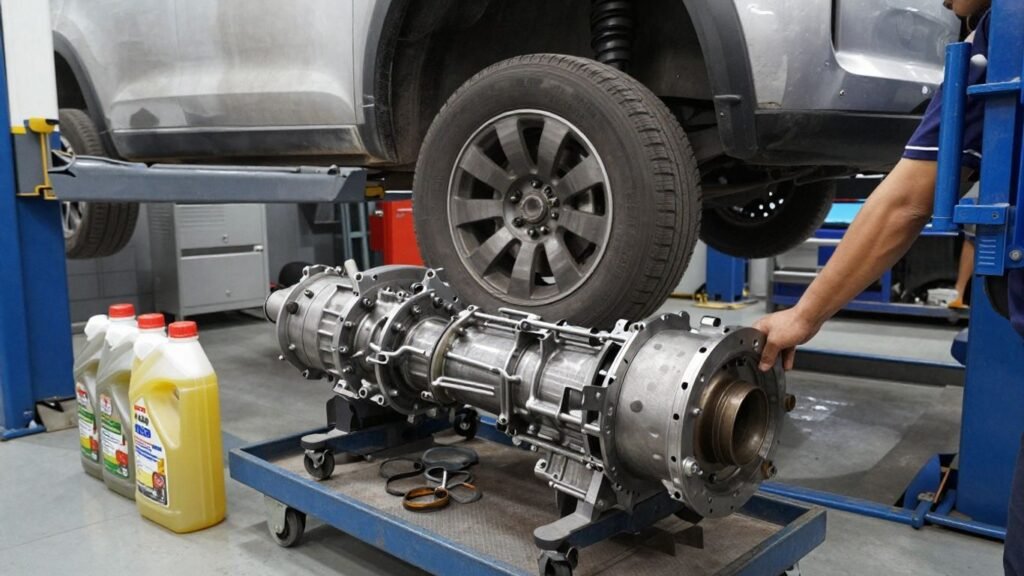
![Remanufactured transmission beside repair tools]
(image:img-2)
Typical pricing factors
Pricing varies with vehicle application, transmission design, availability, preparation standard, warranty, and shipping distance. A common vehicle with a readily available unit may cost less than a low-volume application with scarce cores. Special configurations, integrated electronics, or four-wheel-drive components can also change the quote.
Compare like with like. A cheaper unit with a shorter warranty or fewer included components is not equivalent to a more complete unit with testing and support. The right comparison includes the installed price and the likelihood of additional work discovered during diagnosis.
Core charges and refundable deposits
A core charge protects the supplier if the failed unit is not returned or cannot be reused. It may be waived when the core is supplied at the time of sale, or it may be added temporarily and refunded after inspection. The terms should state the deadline, shipping responsibility, qualifying condition, and possible deductions.
Ask how the supplier treats missing parts, a disassembled case, damaged external housing, or a core that is not the expected model. A written policy may allow some deductions while preserving part of the deposit. Never assume that the full charge will be returned automatically when a box reaches the warehouse.
Labor, fluids, programming, and additional parts
Installation labor depends on vehicle design, access, rust, related damage, and the shop’s procedure. The estimate may also need to include fluid, filters, seals, cooler service, mounts, diagnostics, programming, adaptive learning, freight, and disposal. If the original failure spread debris through the cooler circuit, cleaning that system may be necessary to protect the replacement.
A practical estimate separates the expected work from conditional work. It should say what happens if the torque converter, cooler, wiring, or control module is found to be defective. This is where buyer enablement resources can be helpful as a general decision-making principle: clear information reduces administrative friction and helps people compare complex purchases without pressure.
Comparing exchange costs with rebuilding or replacement
An exchange unit offers speed and a defined purchasing path, while rebuilding the existing transmission may allow the shop to address the exact damage found inside it. A used unit may carry a lower initial price but less certainty about history and remaining life. These options should be compared using the same assumptions for labor, fluids, programming, warranty, and return freight.
| Cost category | Exchange unit | Local rebuild | Used replacement |
|---|---|---|---|
| Unit price | Supplier quote and core terms | Parts and shop labor | Donor-unit price |
| Repair time | Depends on stock and shipping | Depends on diagnosis and queue | Depends on availability and inspection |
| History or specification | Ask for documented preparation | Shop-defined process | Often limited donor history |
| Warranty | Written supplier terms | Rebuilder’s written terms | Often narrower or shorter |
The table is a starting framework, not a promise about any particular supplier. Fill in the actual figures and conditions for the vehicle, then include the cost of returning the core and correcting the original cause of failure.
Warranties, returns, and supplier reliability
Warranty language deserves the same attention as the mechanical specification. Coverage can protect the replacement unit while leaving labor, towing, fluid, diagnostics, or related failures outside the agreement. Returns may also have deadlines and handling charges that apply even when the part is technically eligible. Read the policy before installation, when changing suppliers is still possible.
Understanding parts and labor warranty coverage
Ask whether the warranty covers parts only or both the replacement and reasonable installation labor. Confirm the start date, duration, geographic limits, claim process, and remedy if the unit fails. Some policies provide repair or replacement rather than a cash refund, and freight may be handled differently for the outbound and return shipments.
Get the warranty in writing with the invoice. A verbal statement that a unit is “covered” is not enough to establish what happens after a failure. The supplier’s published policy may specify terms such as an 18-month or three-year warranty, but the exact policy and invoice should govern the purchase.
Reviewing exclusions and maintenance requirements
Exclusions may cover incorrect fluid, overheating, contamination, racing, misuse, improper installation, unauthorized disassembly, or failure of another component. Maintenance requirements can include filter replacement, cooler flushing, fluid documentation, and completion of programming or relearn procedures. These requirements are not minor details; they can determine whether a claim is accepted.
Before installation, give the shop the warranty instructions and ask it to confirm which steps it will document. If the policy requires a particular fluid or procedure, the invoice should identify it. That record can be more useful than a general assurance that the work was completed correctly.
Checking return policies and restocking fees
A return policy may distinguish between an incorrect part, an unused part, a defective unit, and a customer-ordered application that is no longer wanted. Look for authorization requirements, inspection windows, handling fees, non-refundable freight, and restrictions on installed or disassembled transmissions. Core returns may have a separate process from ordinary merchandise returns.
One published exchange policy, for example, describes a 10% handling fee for certain returns and excludes freight and labor from refunds. That is why the policy should be read before ordering rather than after a compatibility problem appears. Keep the invoice number and all shipping records together.
Evaluating supplier certifications and customer reviews
Certifications, trade-association membership, technical training, and consistent customer reviews can provide useful signals, although none replaces a written specification. Look for reviews that discuss communication, delivery condition, warranty handling, and resolution of problems rather than only a single star rating. A supplier that answers application and core questions clearly is easier to work with when something unexpected occurs.
For repair professionals, ATRA training and certification resources provide an example of the kind of technical support and education associated with an industry trade association. Consumers should still evaluate the actual shop, supplier, warranty, and application involved in their repair.
How to get the best results from an exchange transmission
The replacement unit is only one part of the repair. Results depend on the original diagnosis, the installation procedure, system cleanliness, electronic setup, and follow-up care. Treat the exchange as a coordinated repair rather than a boxed component that solves every surrounding problem. That mindset reduces avoidable disputes and repeat failures.
Choosing a qualified installation shop
Choose a shop that regularly works on the vehicle’s type of transmission and can explain its diagnostic, installation, programming, and testing process. Ask who handles warranty claims and whether the shop will communicate directly with the supplier. A detailed written estimate is a better sign than a vague promise of a quick installation.
The shop should be willing to discuss the cause of failure and the condition of related parts. It should also have a plan for safe lifting, fluid handling, cooler service, scanning, and road testing. Experience with the exact application matters more than a generic claim to service every vehicle.
Addressing the original cause of transmission failure
A replacement can fail early if the cause of the first failure remains unresolved. Possible contributors include overheating, restricted cooling, contaminated fluid, wiring faults, poor voltage, damaged mounts, incorrect calibration, or a problem elsewhere in the drivetrain. The technician should identify which causes were tested and which corrective actions are included.
Do not authorize a replacement based only on the most dramatic symptom. A failed sensor, control issue, or cooler problem may require a different repair, while a genuinely damaged transmission may require several supporting steps. The written diagnosis should connect the proposed work to the observed evidence.
Completing break-in and post-installation service
Follow the supplier’s instructions for initial operation, fluid checks, and any break-in period. Avoid towing or severe use until the shop confirms that the unit is operating correctly and the fluid level has been checked at the specified temperature. Some vehicles also need adaptive learning or a follow-up scan after driving.
Schedule the recommended post-installation inspection rather than waiting for a new symptom. Early attention to a leak, unusual shift, warning light, or noise is usually simpler than continuing to drive and complicating a warranty claim. The vehicle owner should know which symptoms warrant an immediate return to the shop.
Keeping records for warranty protection
Keep the invoice, diagnosis, transmission identification, core-return receipt, warranty, fluid records, programming documentation, and post-installation inspection notes. Photograph the replacement and any labels before it is installed. If a claim becomes necessary, these records show what was purchased, who installed it, and whether the required procedures were followed.
A simple file also makes future maintenance easier. Record the date, mileage, fluid specification, supplier contact, and symptoms that led to the repair. Clear records protect options when a repair needs follow-up.
Conclusion
A transmission exchange program can be a sensible way to obtain a prepared replacement without waiting for a complete local rebuild, but its value depends on details. Confirm the diagnosis and application, understand core and warranty terms, budget for installation and electronic setup, and use a shop that will test the finished repair. With those checks in place, the exchange becomes a controlled repair decision rather than a gamble based on a headline price.
Frequently Asked Questions
What is a transmission exchange program?
It is an arrangement in which a replacement transmission is supplied while the failed transmission is returned as a core. The supplier’s price and policies determine how the core is evaluated and credited.
Is an exchange transmission the same as a rebuilt transmission?
No. “Exchange” usually describes the core-return purchasing arrangement, while “rebuilt” describes work performed on a transmission. Ask the supplier what inspection, parts replacement, machining, and testing are included.
Why is a core charge added to the price?
A core charge is a deposit used when the failed transmission is not supplied immediately. It may be refunded or adjusted after the supplier receives and inspects the core under its written policy.
How do I know which replacement transmission fits my vehicle?
Provide the VIN, engine, drivetrain, year, transmission code, and photographs of identification labels or connectors. Confirm the application with the supplier before ordering.
Does installation include programming?
Not always. Some vehicles require programming, relearning, or control-system checks after installation, so ask the shop whether those services are included in the estimate.
What does a transmission warranty usually cover?
Coverage varies. It may apply to the replacement parts, installation labor, or both, while excluding fluids, towing, contamination, overheating, misuse, or failures caused by related components.
Should I choose an exchange, rebuild, or used transmission?
Compare the complete installed cost, expected repair time, documented preparation, warranty, availability, and vehicle value. The best choice depends on the diagnosis and the specific terms offered.