
Key Takeaways
A professional gearbox assessment does more than identify a noisy or slipping unit. It connects symptoms to measurable causes, estimates the likely scope of work, and gives the owner a rational basis for choosing repair, rebuilding, replacement, or continued monitoring.
- A proper assessment considers mechanical, electrical, lubrication, and operating conditions.
- Noise, heat, leaks, slipping, and delayed engagement should not be dismissed as minor symptoms.
- Diagnosis usually combines records, visual checks, fluid inspection, testing, and electronic data.
- A useful report explains the damage, root cause, safety implications, and available options.
- Repair decisions should account for reliability, downtime, warranty, and total ownership cost.
What a professional gearbox assessment covers
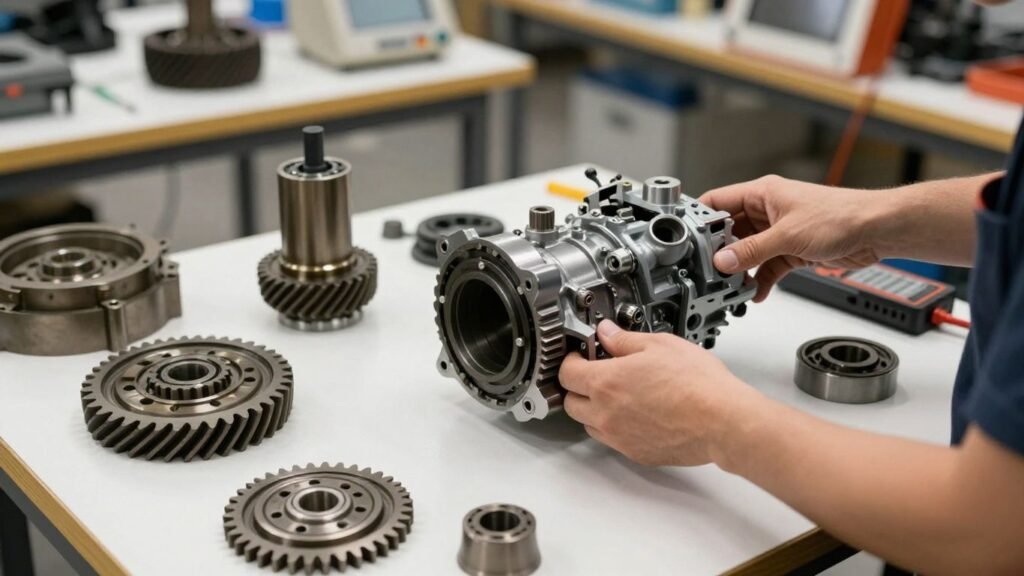
A professional gearbox assessment begins with the unit as a complete system, not just the part making the most noise. The technician considers how the gearbox is used, what symptoms have appeared, and whether other systems could be creating similar signs. The result should be a defensible picture of condition rather than a quick guess based on one observation.
Internal components evaluated during the inspection
Depending on the gearbox type and the evidence available, an inspection may consider gears, bearings, shafts, splines, synchronizers, clutches, seals, housings, and fasteners. Technicians look for pitting, scoring, chipped teeth, abnormal contact patterns, looseness, distortion, and evidence of movement where there should be none. Clearances and backlash matter because a component can appear intact while operating outside its intended range.
The inspection also considers how parts interact. A worn bearing can alter gear alignment, while a damaged seal can reduce lubrication and accelerate wear elsewhere. That chain of evidence is often more useful than labeling one component as “bad” without explaining why it failed.
Mechanical, electrical, and lubrication systems
Modern gearboxes may combine mechanical parts with sensors, solenoids, wiring, and electronic control units. A sound assessment therefore checks both physical operation and the signals that control shifting or engagement. Fluid level, condition, contamination, viscosity, and the presence of metallic debris can provide early clues about internal distress.
Lubrication deserves particular attention because the wrong fluid, an inadequate level, or restricted flow can cause damage that resembles ordinary wear. Executive Transmissions describes diagnostic work covering automatic and manual gearboxes as well as electronic and mechanical repair contexts; the broader lesson is that diagnosis should match the design of the unit rather than rely on one generic test.
Vehicle, machine, and operating conditions that affect the diagnosis
Load, speed, temperature, duty cycle, towing, stop-and-go use, shock loading, and maintenance history all influence gearbox behavior. A machine that runs continuously under a heavy load presents different evidence from a passenger vehicle that produces a symptom only when cold. The technician should record when the problem occurs, what precedes it, and whether the condition changes with temperature or load.
The surrounding system matters too. Mounts, couplings, driveshafts, differentials, axles, engines, and control modules can transmit vibration or cause poor engagement. Without that context, a gearbox may be blamed for a fault that originates elsewhere.
When a basic inspection is not enough
A basic inspection may identify a leak, a damaged mount, or a clearly abnormal fluid condition, but it cannot always determine the full repair scope. If symptoms persist, measurements conflict, or the unit is safety-critical, further testing is justified. A structured consultation process is a useful general reminder: decisions improve when the specialist explains what was checked, what remains uncertain, and what evidence supports the recommendation.
The next step might be a controlled road or load test, pressure testing, borescope inspection, electronic scan, or partial disassembly. The aim is not to dismantle every gearbox automatically. It is to gather enough reliable evidence to avoid both unnecessary work and an incomplete repair.
Signs that indicate a gearbox needs expert attention
Gearbox problems rarely arrive with a complete explanation attached. A small change in sound, shift quality, temperature, or fluid condition can be the first visible part of a larger problem. Early assessment may preserve more repair options, while continued operation under severe symptoms can turn a manageable defect into extensive damage.
Noise, vibration, slipping, and delayed engagement
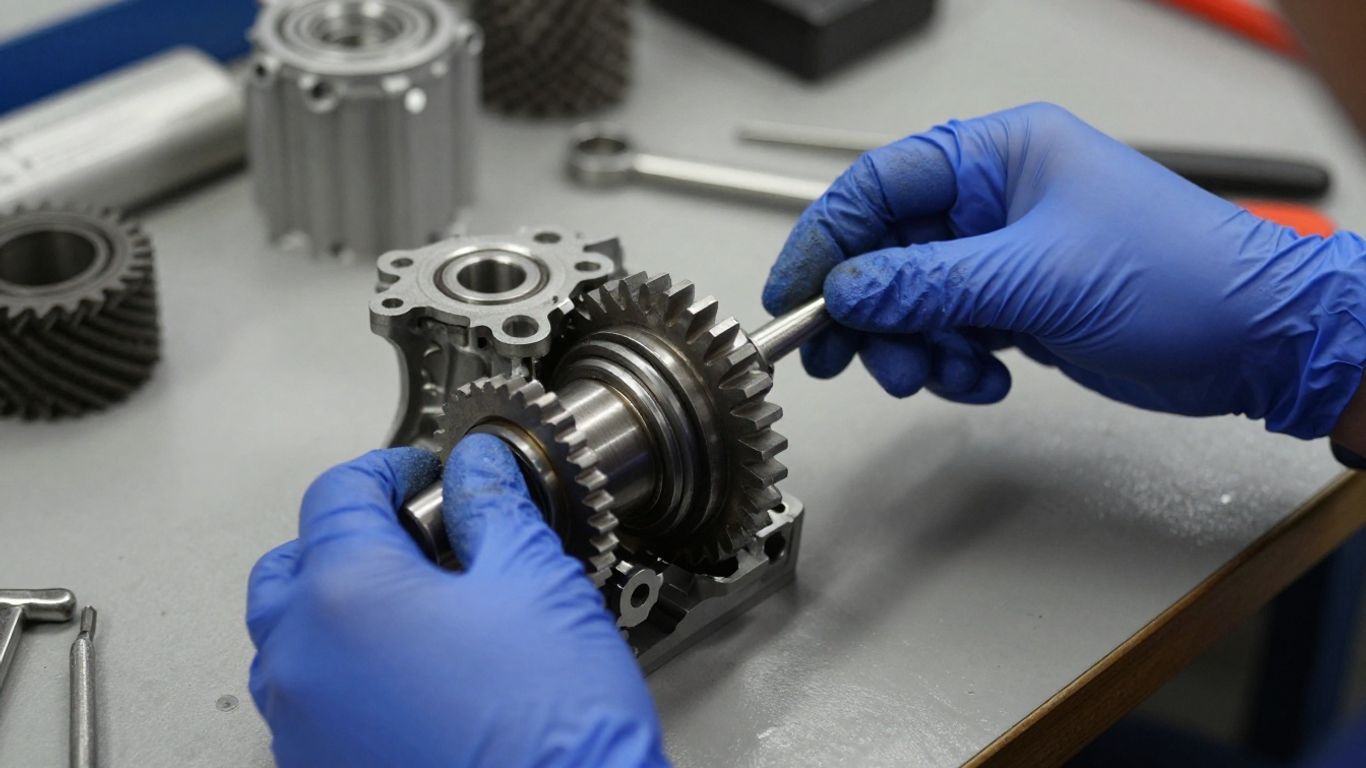
Whining, humming, grinding, clunking, rattling, shuddering, and vibration should be described by when they occur rather than simply called “strange.” Does the sound change with vehicle speed, engine speed, gear selection, acceleration, or deceleration? Does engagement hesitate, flare, or feel harsh? Those details help separate gear mesh, bearing, clutch, mount, and control concerns.
Slipping is especially serious when engine speed rises without a matching increase in output. Delayed engagement may involve fluid pressure, clutch wear, electronic control, or internal leakage. A short drive may reveal the symptom, but it should be conducted safely and with attention to whether continued operation risks further damage.
Fluid leaks, overheating, and unusual odors
A fluid mark under a vehicle or machine does not identify the source by itself. Fluid can travel along housings, covers, lines, and seals before reaching the ground. The technician should locate the leak, verify the fluid type, check the level, and inspect whether the fluid contains discoloration or particles.
Overheating and burnt odors can indicate excessive friction, restricted cooling, poor lubrication, overload, or repeated slipping. These symptoms deserve prompt attention because heat can affect seals, friction materials, bearings, and gear surfaces at the same time.
Warning lights and electronic control issues
A warning light may indicate a stored fault, an active sensor problem, abnormal pressure, or a control strategy responding to detected behavior. Clearing the code without testing the underlying condition removes evidence rather than fixing the cause. Scan data should be interpreted alongside symptoms, service history, and physical inspection.
Electronic issues can also appear as intermittent harsh shifts, failure to select a gear, limp mode, or inconsistent engagement. Wiring, connectors, sensors, solenoids, and software-related controls may all need consideration before internal mechanical damage is confirmed.
Performance changes that can point to hidden damage
A gearbox can deteriorate gradually while still moving the vehicle or machine. Reduced efficiency, a narrower usable speed range, new vibration under load, or a change in shift timing can signal developing wear. Because these changes are easy to adapt to, operators should compare current behavior with normal behavior rather than wait for total failure.
A practical symptom record should include the operating temperature, selected gear, load, speed, frequency, and any related warning light. That simple record often gives the specialist a better starting point than a vague report that the gearbox “feels off.”
How professionals diagnose gearbox problems
Diagnosis is a process of narrowing possibilities. Professionals combine what the operator experienced with what the unit shows under inspection and test. No single reading should be treated as conclusive when the symptom, measurement, and physical evidence do not agree.
Reviewing operating history and service records
The first questions usually concern age, mileage or operating hours, service intervals, fluid changes, previous repairs, modifications, overloads, accidents, and recent changes in use. A pattern of missed maintenance or repeated overheating may point toward a different root cause than a sudden failure after a coupling or control-system change.
Service records also help establish what parts and fluids were previously used. They can reveal recurring symptoms, unfinished repairs, or a component that has already been replaced without addressing the condition that damaged it.
Performing visual and fluid inspections
A visual inspection can reveal cracked housings, loose fasteners, damaged mounts, line problems, seal leakage, corrosion, and signs of impact. Fluid inspection adds another layer by showing level, color, odor, metallic particles, water, debris, or friction-material contamination. Samples should be collected and handled appropriately if laboratory analysis may be needed.
These checks are not merely preliminary paperwork. They can prevent an incorrect test plan and may show that the gearbox is being affected by an external condition such as misalignment or inadequate cooling.
Using road tests, load tests, and pressure checks
A controlled test reproduces the symptom under known conditions. For a vehicle, this may involve acceleration, deceleration, shifts, turns, and temperature changes. For industrial equipment, the technician may observe operation at defined loads and speeds. Pressure checks can help assess hydraulic performance where applicable.
The test should be documented rather than remembered loosely. Useful observations include the exact point of engagement, sound location, vibration intensity, temperature, pressure behavior, and whether the symptom follows speed, load, or gear selection.
Applying computerized diagnostics and vibration analysis
Computerized diagnostics can identify stored codes, sensor readings, commanded actions, and operating patterns. Vibration analysis can help identify frequency-related clues associated with gears, bearings, shafts, couplings, or imbalance. These tools support diagnosis; they do not replace mechanical judgment.
A helpful comparison is the difference between a measurement and an explanation. The measurement may show an abnormal frequency or pressure, while the explanation requires checking the unit’s design, physical condition, and operating circumstances. A useful diagnostic service guide likewise treats assessment as a sequence that leads toward a repair decision, not as a code-reading exercise.
The video placeholder can supplement the written explanation, but it should not substitute for a unit-specific inspection. Gearbox designs, loads, and failure histories vary too widely for a generic demonstration to settle an individual case.
When disassembly or laboratory testing is necessary
Disassembly becomes more reasonable when external checks cannot explain the symptom, when internal damage is suspected, or when the cost of continued operation is high. Parts should be labeled, measured, and photographed as they are removed so the condition can be reconstructed rather than inferred after cleaning.
Laboratory testing may help when fluid contamination, unusual wear, or material failure needs confirmation. It is most valuable when the result will change the repair scope, maintenance plan, or decision to replace the unit.
How gearbox damage is identified and classified
Damage classification is more than a list of failed parts. The technician needs to determine how severe the condition is, whether it is progressive, and what caused it. That distinction affects the reliability of a repair and the likelihood that the same problem will return.
Distinguishing wear from sudden component failure
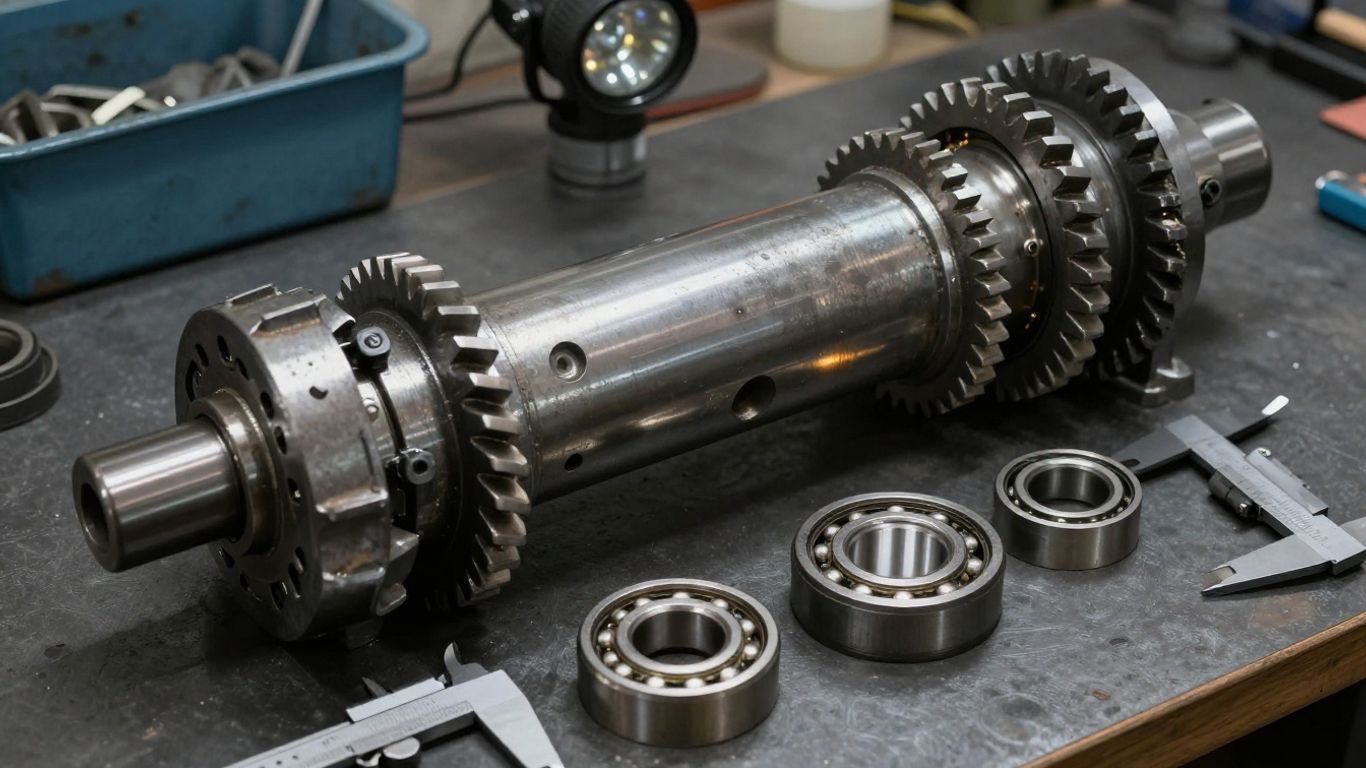
Wear often leaves a pattern: repeated contact marks, gradual pitting, polished surfaces, thinning friction material, or increasing clearance. Sudden failure may produce fractured teeth, a broken shaft, a seized bearing, or impact marks with little preceding wear. In practice, both can occur together when a worn component finally breaks.
The technician should compare the damage with operating history and maintenance records. A broken part is not automatically the root cause; it may be the final result of misalignment, overload, lubrication loss, contamination, or a control fault.
Assessing gears, bearings, shafts, seals, and clutches
Gears are checked for tooth profile, pitting, scoring, cracks, and abnormal contact. Bearings are examined for brinelling, spalling, looseness, discoloration, and rough rotation. Shafts are checked for runout, wear at journals and splines, and signs of twisting. Seals are assessed for hardening, cuts, distortion, and installation-related damage.
Clutches and friction elements require attention to wear, glazing, heat marks, warping, contamination, and engagement surfaces. Measurements should be compared with the manufacturer’s specifications when available, not judged only by appearance.
Recognizing contamination, overheating, and lubrication failures
Metal, water, dust, seal fragments, and friction material can change the way a gearbox operates and accelerate damage. Heat discoloration, varnish, burnt fluid, or hardened seals may point to sustained temperature problems. A low fluid level may be the visible result of a leak, but the deeper issue could be a maintenance gap or an installation fault.
The classification should connect the evidence to a mechanism. For example, contamination may explain abrasive wear, while inadequate lubrication may explain scoring and bearing distress. That connection is what makes a repair recommendation credible.
Separating gearbox faults from engine, drivetrain, or control-system issues
Some symptoms cross system boundaries. A vibration may originate in a coupling, mount, driveshaft, differential, or engine rather than inside the gearbox. A harsh shift may involve software, a sensor, hydraulic control, or an engine-management response. Testing should isolate the condition before internal work is authorized.
This is also where root-cause evidence matters. Replacing a visibly damaged component without correcting the external source may produce a short-lived improvement and a repeat failure.
What a professional gearbox assessment report should include
A report turns technical observations into a decision that an owner, fleet manager, or maintenance team can act on. It should distinguish confirmed findings from likely causes and unresolved questions. Clear documentation also gives the owner something to compare against the final invoice and post-repair performance.
Documented findings, measurements, and photographs
The report should identify the unit, operating context, symptoms, test conditions, measurements, fluid observations, and parts examined. Photographs are particularly useful for damaged teeth, bearing surfaces, leaks, contamination, heat marks, and cracked housings. A report built from specific evidence is easier to review than one filled with general terms such as “worn” or “needs attention.”
For industrial units, a documented repair evaluation report commonly includes photographs and observations after the unit has been assessed. The same documentation principle applies to vehicle and machine gearboxes, even though the testing sequence may differ.
A clear explanation of the root cause
The report should explain what failed, why it likely failed, and what evidence supports that conclusion. If the cause is uncertain, that uncertainty should be stated plainly, along with the additional inspection needed to resolve it. A list of damaged parts without causation leaves the owner exposed to repeat failure.
The explanation should also identify contributing conditions such as overload, contamination, poor alignment, incorrect fluid, overheating, or deferred maintenance. That makes the recommendation useful beyond the immediate repair.
Repair, rebuild, replacement, and monitoring recommendations
Recommendations should be tied to condition and risk. A minor external repair may be enough when internal measurements are within limits. A rebuild may be appropriate when the housing and major components remain serviceable, while replacement may make more sense when damage is extensive or parts support is poor.
Monitoring can be reasonable when symptoms are mild and the risk is understood, but it should include defined checks, intervals, and stop-use criteria. A repair process guide such as Illinois Electric Works highlights inspection, disassembly, cleaning, and component assessment as distinct steps; separating those steps helps clarify what a quoted job actually includes.
Estimated costs, timelines, and safety considerations
A useful estimate separates inspection, parts, labor, machining, fluid, testing, taxes, and possible contingencies. It should state what could change the price once the unit is opened. Timing should distinguish parts lead time from technician work and final testing.
Safety considerations belong in the report when continued operation could worsen damage or create a hazard. The owner should know whether the unit can be driven, run under reduced load, or needs to be removed from service immediately.
Questions to ask before approving the work
Before authorizing repairs, ask how the diagnosis was confirmed, which parts are reusable, what caused the failure, what warranty applies, and how the finished unit will be tested. Ask whether the quoted price includes cleaning, seals, fluid, calibration, and final inspection. A structured question set, similar in spirit to the gearbox repair process, helps turn a verbal recommendation into an understandable scope of work.
Those answers should be specific enough to compare options. If the explanation changes whenever a new question is asked, pause before approving a major expense.
How to choose the right next step after an assessment
The assessment is valuable only when it leads to a proportionate decision. Cost matters, but so do downtime, expected service life, safety, parts availability, warranty, and the consequences of another failure. The right choice is the one that fits the equipment’s role and the evidence, not automatically the cheapest initial quote.
When repair is more practical than replacement
Repair may be sensible when damage is localized, the housing and main components are sound, and replacement would create long delays or compatibility problems. It is especially attractive when the technician can identify the cause and verify the repaired unit under appropriate conditions. A general repair versus replacement guide also reflects the practical point that repair can reduce both expense and downtime in suitable cases.
The decision should still account for hidden damage. A low repair price is not a value if it excludes worn related parts or fails to address the reason the gearbox failed.
When rebuilding offers better long-term value
Rebuilding can offer a controlled reset when multiple wear items are near the end of their useful life but the core housing and major components remain viable. It may include cleaning, measurement, replacement of selected parts, machining, new seals, reassembly, and testing. The exact scope should be written down rather than assumed from the word “rebuild.”
A rebuild is less attractive when the housing is badly damaged, critical parts are unavailable, or the expected service life cannot justify the investment. The assessment should make those limitations visible.
Factors that affect total ownership cost
Purchase price is only one part of the decision. Compare the likely costs and consequences across the available options:
- Repair or rebuild price, including possible teardown findings.
- Downtime, shipping, installation, setup, and testing time.
- Warranty coverage, parts availability, and future serviceability.
- Expected life, operating risk, energy use, and the cost of another failure.
This broader comparison can change the preferred option. A more expensive path may be reasonable if it reduces repeated downtime, while a cheaper path may be adequate for a low-use machine with manageable consequences.
Planning preventive maintenance after the assessment
The final recommendation should include a maintenance plan tailored to the unit. It may cover fluid checks, sampling, leak inspection, temperature monitoring, alignment, coupling condition, fastener checks, and operating limits. Maintenance intervals should reflect actual duty rather than a convenient calendar alone.
Record the baseline after repair: sound, vibration, temperature, pressure, fluid condition, and shift behavior. That baseline makes future changes easier to detect and helps distinguish normal variation from deterioration.
Warning signs of an incomplete or unreliable diagnosis
Be cautious when a diagnosis relies on one symptom, provides no measurements, cannot explain the root cause, or recommends replacement before basic checks are complete. Vague pricing, no written scope, pressure to approve immediately, and refusal to show damaged parts are also reasons to ask for clarification.
A sound assessment acknowledges uncertainty and explains how it will be reduced. It should leave the owner with evidence, options, and clear boundaries around what is known rather than confidence unsupported by inspection.
Conclusion
A professional gearbox assessment gives structure to a difficult decision: it connects symptoms, measurements, component condition, operating history, and likely cause before money is committed. With a clear report and a realistic view of repair, rebuilding, replacement, and maintenance, owners can choose the option that best protects safety, uptime, and long-term value.
Frequently Asked Questions
What is included in a professional gearbox assessment?
It may include an operating-history review, visual inspection, fluid checks, electronic diagnostics, road or load testing, pressure testing, vibration analysis, and—when justified—disassembly or laboratory testing.
How long does a gearbox assessment take?
The time varies with gearbox design, symptom severity, access, and whether testing or disassembly is required. A basic external assessment may be relatively quick, while a full internal evaluation takes longer.
Can a gearbox be assessed without removing it?
Often, yes. External inspection, fluid analysis, electronic scans, operating tests, and vibration measurements can reveal useful evidence. Removal or disassembly may still be necessary when those methods cannot confirm the damage.
Is gearbox noise always a sign of major damage?
No. Noise can come from mounts, couplings, bearings, gear contact, fluid problems, or nearby drivetrain components. Its timing, frequency, and relationship to load or speed help determine its significance.
When should a gearbox stop being operated?
Stop operation when there is severe grinding, loss of engagement, rapid overheating, substantial leakage, smoke, a safety-related loss of control, or a risk that continued use will worsen the failure. A qualified assessment can define safer limits when the situation is less severe.
Is repair usually better than replacement?
Neither option is automatically better. The decision depends on the damage, housing condition, parts availability, downtime, warranty, expected life, compatibility, and total ownership cost.
What should a gearbox report say about uncertainty?
It should separate confirmed findings from probable causes and unresolved questions. It should also explain what additional test, measurement, or disassembly would be needed before making a more certain recommendation.