

Key Takeaways
A transmission trouble code reader can narrow a difficult problem, but it does not replace testing. The most useful scan is one that preserves the vehicle’s data and leads to a sensible inspection.
- Read transmission and engine-related modules separately when the tool allows it.
- Check compatibility before buying a reader or assuming it can access the transmission module.
- Save codes, status, and freeze-frame information before clearing anything.
- Treat a trouble code as a starting point rather than a confirmed failed part.
- Stop driving and seek professional help when shifting, fluid loss, or warning symptoms are severe.
What a transmission trouble code reader does
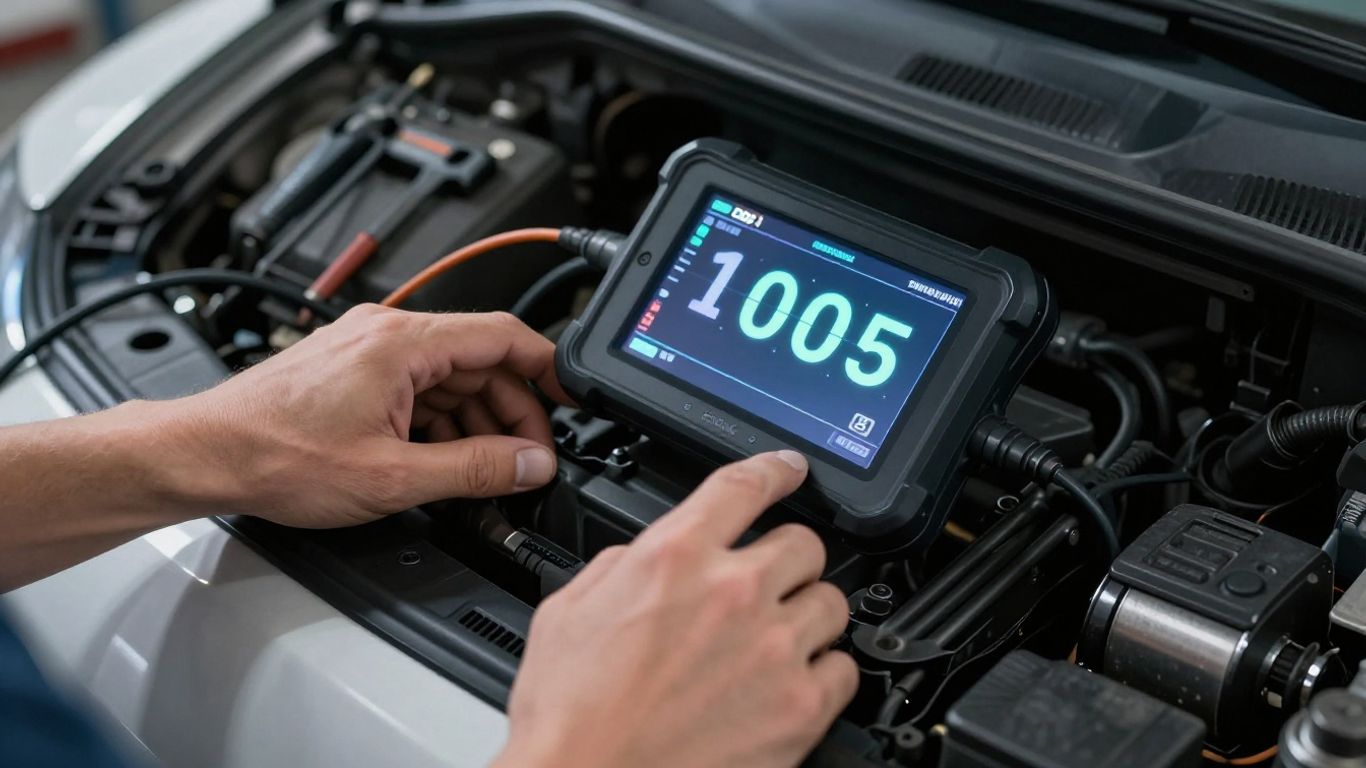
A transmission trouble code reader communicates with one or more electronic control modules and retrieves diagnostic trouble codes. Depending on the vehicle and tool, it may also show live sensor readings, freeze-frame information, and code status. That information helps turn a vague symptom into a more focused inspection, although mechanical checks are still necessary.
How transmission diagnostic codes differ from engine codes
Engine and transmission faults can share the same powertrain warning light, but they describe different control systems and operating conditions. A code reader that only checks the engine module may miss a fault stored in the transmission control module. General background on reading transmission codes is also available in this OBD2 transmission code guide.
The distinction matters because a broad code such as a transmission-control malfunction may simply indicate that another, more specific code needs to be retrieved. The reader is useful when it identifies where the fault was recorded, not when it encourages a guess from the warning light alone.
Which vehicle systems a reader can access
Basic readers commonly retrieve emissions-related powertrain information, while more capable tools may communicate with transmission, ABS, airbag, body, or network modules. Access depends on the vehicle’s architecture, the reader’s software, and whether enhanced manufacturer coverage is included. A scan tool should state these functions clearly rather than leaving the buyer to infer them from the number of supported vehicles.
On some vehicles, the transmission module is separate; on others, its functions are integrated with another controller. That is why a reader can work correctly at the OBD-II port yet still be unable to open the menu needed for transmission data.
Code readers versus full-featured scan tools
A simple reader is often enough to retrieve and clear basic powertrain codes. A full-featured scan tool may add live data, graphing, module selection, service functions, and bidirectional controls. The difference is not merely screen size: it is the depth of communication and testing available after the initial code is found.
A useful comparison is the difference between generic and factory-level diagnostic access. This scan tool transmission guide discusses that distinction and the role of scan data in narrowing faults. For occasional use, a smaller tool may be practical; for repeated diagnosis, deeper data access can save time.
Why vehicle compatibility matters
Compatibility is more than an OBD-II connector fitting under the dashboard. Check the vehicle year, make, model, engine, transmission, communication protocol, and supported module list. Updates can also affect coverage, so confirm whether software updates are included and for how long.
If the tool cannot identify the transmission module, no amount of repeated scanning will produce the missing data. Write down the vehicle identification number and compare it with the manufacturer’s coverage information before purchasing.
How to choose the right transmission trouble code reader
The right reader depends on what you need to learn, how often you will use it, and whether you are prepared to perform follow-up tests. A low-cost device may answer a basic question, while a more advanced unit can make a road test or electrical diagnosis much more informative. Choose for the next diagnostic step, not just the first code display.
Essential features for transmission diagnostics
Look for module selection, transmission code retrieval, freeze-frame data, live data, code definitions, and the ability to save or export a report. A clear display and a stable connection matter too, especially when readings must be watched while the vehicle is moving. Useful diagnostic detail is usually more valuable than a long list of maintenance resets.
Consider these features in relation to the problem you actually expect to investigate:
- Transmission control module access for the target vehicle.
- Live data for speed, temperature, pressure-related, or command values when supported.
- Freeze-frame and report-saving functions for preserving the moment a fault appeared.
- Software updates that maintain vehicle and module coverage.
After scanning, those features should help you form a test plan. They cannot, by themselves, prove that a solenoid, sensor, or internal transmission component has failed.
Wired, wireless, and smartphone-based options
Wired readers are simple to connect and do not depend on a separate wireless adapter or phone battery. Wireless tools can be convenient when the display, recording, and storage are handled by an app, but connection stability and app support deserve attention. Smartphone-based options also require a compatible operating system and a device that can remain available during testing.
Whichever format you choose, make sure the tool can display the module and data you need before buying. Convenience is helpful, but a polished interface cannot compensate for missing transmission coverage.
Coverage for make, model, and transmission type
Read the coverage list by vehicle, not only by brand family. A tool may support one model year or powertrain while excluding another, and some functions may be available only on selected transmissions. Coverage pages should distinguish code reading from advanced tests, adaptations, or programming.
A reader intended for one household vehicle can be chosen differently from a tool used across many makes. If you service unfamiliar vehicles, favor transparent coverage documentation and current software rather than relying on a general compatibility claim.
When bidirectional controls are worth the cost
Bidirectional controls let a scan tool send selected commands to a module, when the vehicle supports them, instead of only listening for stored information. They can help a trained user observe whether a component responds to a commanded test. These functions require care because an incorrect command can create confusing results or change system behavior.
For occasional code checks, bidirectional capability may not justify the added cost. It becomes more valuable when you regularly diagnose solenoids, actuators, or communication faults and understand the safety conditions for each test.
How to scan a vehicle for transmission codes
Scanning is most useful when the vehicle is treated as evidence rather than a puzzle to rush through. Record the symptoms, warning lights, recent repairs, and driving conditions before connecting the reader. Then work methodically so the first scan preserves information that may disappear after a reset.
Preparing the vehicle and scan tool
Park safely, apply the parking brake, and follow the tool’s instructions for ignition position. If a road test will follow, arrange a safe route and a second person to observe the screen when possible. Confirm that the battery is adequately charged, since low voltage can create communication problems or misleading codes.
Write down when the fault occurs: cold start, acceleration, steady speed, reversing, or a particular shift. Those details give the code context and help you reproduce the condition without driving aimlessly.
Connecting to the OBD-II port safely
Locate the diagnostic connector without forcing the plug or disturbing nearby wiring. Turn the ignition off unless the reader’s instructions specify otherwise, connect it securely, and then switch to the required ignition position. Keep cables clear of pedals and the driver’s feet.
A connection that repeatedly drops should be treated as a problem to investigate, not an inconvenience to ignore. Inspect the connector for damage and verify battery voltage before blaming the vehicle module.
Selecting the transmission control module
Use the menu to identify the transmission control module or the vehicle’s equivalent powertrain module. Do not stop after a global scan if the tool offers individual module access; the specific transmission menu may contain additional codes and data. If no module appears, check compatibility, ignition status, and communication voltage.
A careful scan sequence usually looks like this:
- Perform a full vehicle scan and record every module that reports a fault.
- Open the transmission or relevant powertrain module separately.
- Read stored and pending codes without clearing them.
- Review live data only after the initial records are saved.
This sequence keeps the broad picture while still giving the transmission module its own attention. It also makes it easier to notice a network or voltage fault affecting several systems.
Saving codes and freeze-frame data
Save the exact code, description, status, mileage if shown, and freeze-frame values before disconnecting the reader. Freeze-frame data may show speed, temperature, throttle position, or other operating conditions captured when the fault was recorded. Photographing the screen is a simple backup when the tool cannot export a report.
Do not rely on memory or on a generic description copied without the code’s status. The stored record is often the clearest link between the symptom and the conditions that triggered it.
How to interpret transmission trouble codes
A code is a standardized clue, not a final diagnosis. Its wording describes a monitored circuit, signal, range, or system condition, while the actual cause may be electrical, hydraulic, mechanical, or software-related. Interpretation becomes safer when the code is read alongside symptoms and supporting data.
Understanding generic and manufacturer-specific codes
Generic codes can offer a common starting point across vehicles, but manufacturer-specific codes may contain more detail or use a different definition. The first character and number pattern can help classify a powertrain fault, yet the vehicle’s service information remains the authority for testing procedures. This transmission code reference provides background on common code categories and examples.
Never assume that a familiar number means the same repair on every vehicle. Confirm the exact definition for the vehicle and module that generated it.
Using code descriptions as starting points
A description such as “input speed sensor circuit” points toward a monitored signal and its wiring, not automatically toward a failed sensor. Check the connector, power supply, ground, signal pattern, and related mechanical symptoms before ordering parts. A code description narrows the field; it does not identify which item in that field is defective.
The same principle applies to a transmission-control malfunction. It may be a companion code that requires another module scan, rather than proof that the controller itself must be replaced.
Comparing stored, pending, and permanent codes
Stored codes generally indicate a fault that met the module’s criteria, while pending codes may reflect a condition that has not yet repeated enough to mature. Permanent codes can remain until the vehicle completes the required monitors and confirms that the fault is gone. The precise behavior varies by system and code type.
Record all three statuses. A pending code that appears during a specific road condition can be valuable even when no stored code is present, while a permanent code should not be treated as permission to clear the record repeatedly.
Why one code may have multiple causes
The same signal can be affected by a damaged wire, poor ground, low system voltage, contamination, a sensor, a control module, or an internal mechanical problem. Transmission control strategies also depend on several inputs at once, so one bad signal can create secondary codes. This is why a scan is the beginning of diagnosis rather than the end.
Use the code to choose the next measurement. If the measured signal is correct, move to the next possible cause instead of replacing the part named in the description.
Common transmission problems a reader can help identify
A reader is especially helpful with electronically monitored faults. It can reveal patterns involving solenoids, speed sensors, gear ratios, temperatures, and communication, provided the vehicle and tool support those data. Mechanical wear may still require pressure testing or inspection beyond the scan tool.
Shift solenoid and pressure-control faults
Solenoid-related codes may indicate an electrical circuit problem, an implausible command response, or a pressure-control issue. Symptoms can include harsh, delayed, or inconsistent shifts, but the code alone cannot distinguish a wiring fault from a hydraulic or internal cause. Compare commanded values with available feedback and inspect the related circuit.
Fluid condition and valve-body concerns can also affect pressure behavior. A reader helps identify the electronic clue, while physical testing determines whether the pressure system is responding as it should.
Speed sensor and input-output signal problems
Input and output speed signals help the control system calculate gear operation and vehicle movement. A missing, erratic, or implausible signal can cause delayed shifts, failsafe behavior, or gear-ratio codes. Check whether the live reading changes smoothly and agrees with the vehicle’s actual condition.
Inspect sensor wiring near heat, moving parts, and transmission connectors. A new sensor will not correct an open circuit, poor terminal fit, or damaged harness.
Gear-ratio and slipping-related codes
Gear-ratio codes occur when the module compares expected and observed speeds and finds a mismatch. That mismatch can accompany slipping, but it can also result from inaccurate speed data, low fluid, pressure loss, tire-size changes, or another control fault. A road test with saved data can show when the discrepancy begins.
If the transmission is flaring between gears, failing to engage, or producing unusual noise, avoid repeated hard tests. Continued operation can turn a diagnostic symptom into additional damage.
Communication and voltage-related faults
A transmission module needs stable power, ground, and network communication. Low battery voltage, corroded grounds, damaged network wiring, or another module problem can produce several apparently unrelated codes. When many modules report faults at once, check system voltage and communication conditions before focusing on individual transmission parts.
The pattern of codes is often more informative than one isolated entry. A scan tool can show that pattern, but a wiring diagram and electrical measurements are needed to confirm it.
How to confirm a transmission diagnosis
Confirmation means testing the suspected cause and ruling out reasonable alternatives. Start with simple physical checks, then move to live data and electrical measurements. A careful diagnosis may take longer than replacing a part, but it is less likely to create a second problem.
Checking fluid level, condition, and leaks
Use the manufacturer’s procedure for checking fluid level because temperature, engine state, and fill method vary. Look for leaks around the pan, cooler lines, seals, and axle areas, and note fluid color or odor without treating appearance alone as a diagnosis. Low or incorrect fluid can affect operation and electronic readings alike.
Repairing a leak does not automatically repair damage that occurred while the transmission was low. Recheck the original symptom and codes after the correct service procedure.
Inspecting wiring, connectors, and grounds
Examine transmission connectors for moisture, oil intrusion, bent pins, loose terminals, and damaged locks. Follow the harness far enough to find chafing, heat damage, or previous repair work. Clean, tight grounds and stable power supplies are basic requirements before condemning a module.
Use the wiring diagram for the exact vehicle. Wire colors and connector locations should never be assumed from a similar model.
Using live data during a road test
Live data can show whether speed sensors, temperatures, gear commands, and other supported values behave when the symptom occurs. Compare the reader’s values with road speed, engine behavior, and the actual shift event. Have an assistant operate the tool whenever possible so the driver can focus on the road.
A recording is more useful than a glance at one number. Look for a value that drops out, lags, or disagrees with related signals at the moment the transmission misbehaves.
Testing electrical components with a multimeter
A multimeter can check supply voltage, resistance, continuity, and voltage drop when used with the correct specifications. Disconnect components before resistance testing when required, and avoid probing terminals in a way that spreads or damages them. Compare measurements with the service information rather than with a generic expected value.
Resistance alone may not reveal a fault that appears only under heat, vibration, or load. If a circuit passes a static test but fails during operation, continue with an appropriate loaded or dynamic test.
When professional diagnostic equipment is needed
Professional help is sensible when the transmission will not engage, fluid is disappearing, the vehicle enters a severe failsafe mode, or the fault requires programming, adaptation, pressure testing, or internal inspection. A shop may have wiring information, dedicated pressure equipment, and a scan tool with broader module functions. The goal is not simply to obtain another code, but to test the system safely.
A professional ECU cloning guide is a useful reminder that module work can involve vehicle-network communication, anti-theft considerations, and specialized equipment. Those concerns are separate from ordinary code reading and should not be improvised.
Common mistakes and next steps after scanning
The scan is only valuable if the information is preserved and used carefully. Rushing to clear a warning or buy a part can erase useful clues. After the first reading, pause, organize the evidence, and decide whether the vehicle is safe to operate.
Avoiding parts replacement based on one code
A code identifies a monitored condition, not necessarily a failed component. Confirm power, ground, wiring, fluid condition, related codes, and live data before replacing a sensor, solenoid, or module. If the suspected part is expensive, obtain a second diagnostic opinion or follow the factory test sequence.
This approach also prevents a new component from masking the original problem temporarily. The code should disappear because the cause was corrected, not because the reader was told to forget it.
Clearing codes before recording diagnostic data
Clearing codes resets valuable status information and may erase freeze-frame details. Save screenshots or a report first, including all modules and not only the transmission entry. After repairs, clearing may be appropriate, but only once the original evidence is documented.
The same preserve-before-changing habit appears in practical stain removal guidance, where the first treatment can affect what happens next. The subjects differ, but the diagnostic lesson is familiar: record the condition before altering it.
Knowing when it is safe to continue driving
A vehicle that shifts normally with a minor intermittent code may be suitable for a short trip to a repair facility, but that decision depends on the exact symptoms and manufacturer guidance. Do not continue driving if the transmission slips badly, will not engage, overheats, leaks heavily, or leaves you without predictable control. When in doubt, stop safely and arrange assistance.
Warning lights accompanied by burning odor, severe noise, or sudden loss of drive deserve more urgency than a code alone suggests. A reader cannot assess every mechanical risk from the driver’s seat.
Deciding between DIY repairs and shop service
DIY work can be reasonable for inspection, connector checks, fluid checks performed by the correct procedure, and straightforward repairs supported by reliable service information. Programming, internal transmission work, pressure diagnosis, and uncertain electrical faults are better handled with suitable equipment and experience. Be honest about the tools, time, and safety conditions available.
Vehicle preparation is part of that decision: even a road-trip vehicle checklist stresses checks of fluids, tires, brakes, navigation, and conditions before a long drive. For a transmission fault, the equivalent is confirming that the vehicle can be operated safely before setting out.
Preventing recurring transmission trouble codes
Repair the cause, not merely the stored message. Complete the required fluid service, secure the harness, correct voltage or ground problems, and follow any relearn or drive-cycle procedure specified for the vehicle. Then rescan after the system has had a chance to run its monitors.
It also helps to keep a record of the code, repair, mileage, and conditions when the fault returned. Broader maintenance habits, such as using ingredients before they spoil, similarly depend on tracking conditions instead of waiting for waste or failure; the practical value here is simply better follow-through.
A final source on advertising careers in Israel is unrelated to transmission repair, but it reinforces a general point about specialized work: outcomes depend on the right training and tools. For a complex vehicle fault, that means knowing when a scan result has reached the limit of a home reader.
Conclusion
A transmission trouble code reader is a useful first step because it reveals where the vehicle’s control system noticed an abnormal condition. Save the evidence, interpret the code in context, inspect the basics, and confirm the suspected cause before replacing parts or continuing to drive. That measured process is more reliable than treating any single code as a verdict.
Frequently Asked Questions
Can a basic code reader read transmission codes?
Some basic readers access only generic powertrain information, while others support enhanced transmission modules. Check the exact vehicle and module coverage before buying or assuming the reader can retrieve the needed code.
Is a transmission code the same as a failed transmission?
No. A code can point to a sensor signal, wiring, voltage, fluid, pressure, communication, or internal mechanical issue. Further inspection and testing are needed to identify the cause.
Should I clear transmission codes after scanning?
Record the codes, status, freeze-frame data, and symptoms first. Clearing too early can remove clues, and the warning may return before the underlying problem is understood.
Can I drive with a transmission trouble code?
It depends on the code and symptoms. Severe slipping, overheating, fluid loss, inability to engage, or unpredictable shifting makes continued driving unsafe and warrants professional assessment.
What information should I save from a scan?
Save the exact code, module name, status, freeze-frame values, mileage if available, warning lights, and the conditions under which the fault occurred. Screenshots or an exported report are useful.
Why does the same code keep returning after repair?
The original cause may not have been corrected, or a related wiring, voltage, fluid, or mechanical issue may remain. Recheck the repair and test the complete circuit or system rather than repeatedly clearing the code.
When should a professional diagnose the vehicle?
Seek professional help when the vehicle has severe symptoms, requires programming or adaptation, involves uncertain electrical faults, or needs pressure testing or internal transmission work. Specialized equipment can confirm issues a reader can only suggest.